

What TOSI is, who it catches, how much it costs, and the exceptions that still let you pay family members fairly.
DISCLAIMER: This article is general information, not tax advice. The application of the TOSI rules is based on the specific facts of your ownership structure, who works in the business, and how much they contribute in terms of labour or capital. Before acting on anything here, we recommend that a qualified tax professional review your situation.
A business owner sets up an operating company, issues shares of that company to a spouse in a lower tax bracket, and has the company pay dividends to that spouse each year. The household keeps more of what the business earns. For a long time, that was ordinary planning known as “income splitting”.
Since 2018, the same move can quietly backfire. The dividend meant to be taxed in the spouse's low bracket can instead be taxed at the highest marginal rate. In Ontario, that turns a rate in the single or low double digits into 47.74% on non-eligible dividends. The saving the structure was built to capture disappears, and in some cases the owner does not find out until the return is assessed.
That reversal has a name: the “tax on split income”, or TOSI. It is one of the most misunderstood areas of Canadian private company taxation, partly because the rules are dense and partly because the exceptions are where all the real planning lives. This guide walks through what TOSI is, who it applies to, what it costs, and the specific exclusions that still let you compensate family members who genuinely contribute to the business.
What is tax on split income (TOSI)?
TOSI is a set of rules in section 120.4 of the Income Tax Act (the “Act”) that taxes certain income received from a private business at the top marginal tax rate, regardless of the recipient's actual income level.
The purpose is to shut down "income sprinkling," which is the practice of moving income from a business owner in a high tax bracket to family members in lower brackets in order to reduce the household's overall tax. When TOSI applies, the tax advantage of that shift is removed. The income is taxed as if it were earned by someone already at the top rate.
TOSI is not new in concept. A narrower version, often called the "kiddie tax," has applied to minors since 2000. Starting with the 2018 tax year, the CRA expanded the rules to catch income sprinkled to adult family members as well, including spouses, adult children, parents, and siblings. That expansion is what made TOSI a live issue for most private company owners rather than a niche rule about minors.
Why does TOSI exist?
The logic sits on top of how private corporations are taxed in Canada. When a business earns income through a corporation and pays it out as dividends, the tax paid depends on the recipient's personal bracket. If dividends flow to a family member with little other income, they are taxed lightly. If they flow to the owner at the top rate, they are taxed heavily.
Before 2018, splitting dividends across several lower-bracket family members could save a household a substantial amount each year, even where those family members did no work and took no risk in the business. The federal government viewed this as an unfair advantage available mainly to those who could incorporate, and introduced the expanded TOSI rules to neutralize it.
The important nuance, and the one that gets missed, is that TOSI does not punish paying all family members. Rather, it punishes paying family members who do not contribute. The entire architecture of the rules is a series of exceptions for people who actually work in the business, own a real stake in it, or put capital at risk. Understanding those exceptions is the difference between a structure that works and one that quietly costs you at the top rate.
Who does TOSI apply to?
TOSI only operates where three pieces are present: a “specified individual” receiving the income, a “source individual” connected to the business, and a “related business”. If any one of these is missing, TOSI generally does not apply.
The specified individual is the person receiving the income who could be taxed under TOSI. This is a Canadian-resident individual. In practice, it is the family member the income has been directed to.
The source individual is typically the Canadian business owner. Specifically, it refers to a person resident in Canada who is related to the “specified individual” and connected to the business, typically the higher-income owner the income is being split away from. TOSI is fundamentally about relationships. If the recipient has no related source individual involved in the business, there is no income to "split," and the rules do not bite. This is why paying dividends to a genuinely arm's length investor is not a TOSI problem.
The related business is the business the income comes from. A business is "related" to the individual if a source individual either owns shares representing at least 10% of the value of the corporation, or is actively engaged in the business. This is the link that connects the family member's income back to the family's business.
For minors under 18, the rules are stricter still, and most of the adult exceptions described below are simply not available to them. The practical planning conversation almost always centres on adult family members.
What income is caught by TOSI, and what is not?
TOSI applies to "split income," which is a defined term. It is broad, but it has clear edges. The most important thing to understand is that salary is not split income.
The salary point deserves its own line: Section 120.4 does not apply to salary. If a family member does real work in the business, paying them a reasonable salary for that work is outside TOSI entirely. The catch is that the salary must be reasonable for the work actually performed, because a separate rule in the Act (section 67) limits the deduction for unreasonable amounts. For example, paying $120,000 to a spouse to answer occasional emails leads to a different tax problem, but not TOSI.
How much does TOSI actually cost?
When TOSI applies, the income is taxed at the highest combined federal and provincial marginal rate for that type of income. It is not a penalty on top of tax; rather, it is the removal of the low-bracket benefit the split was designed to produce.
The rates below are the combined federal and Ontario top marginal rates for 2026.
(Note: Ontario's non-eligible dividend rate is scheduled to rise to 48.89% in 2027.)
When TOSI applies, most personal tax credits cannot be used to reduce it. The rules preserve the dividend tax credit, the foreign tax credit, and the disability tax credit, but not the others. The dividend rates above already reflect the dividend tax credit, which is why they sit below the ordinary income rate.
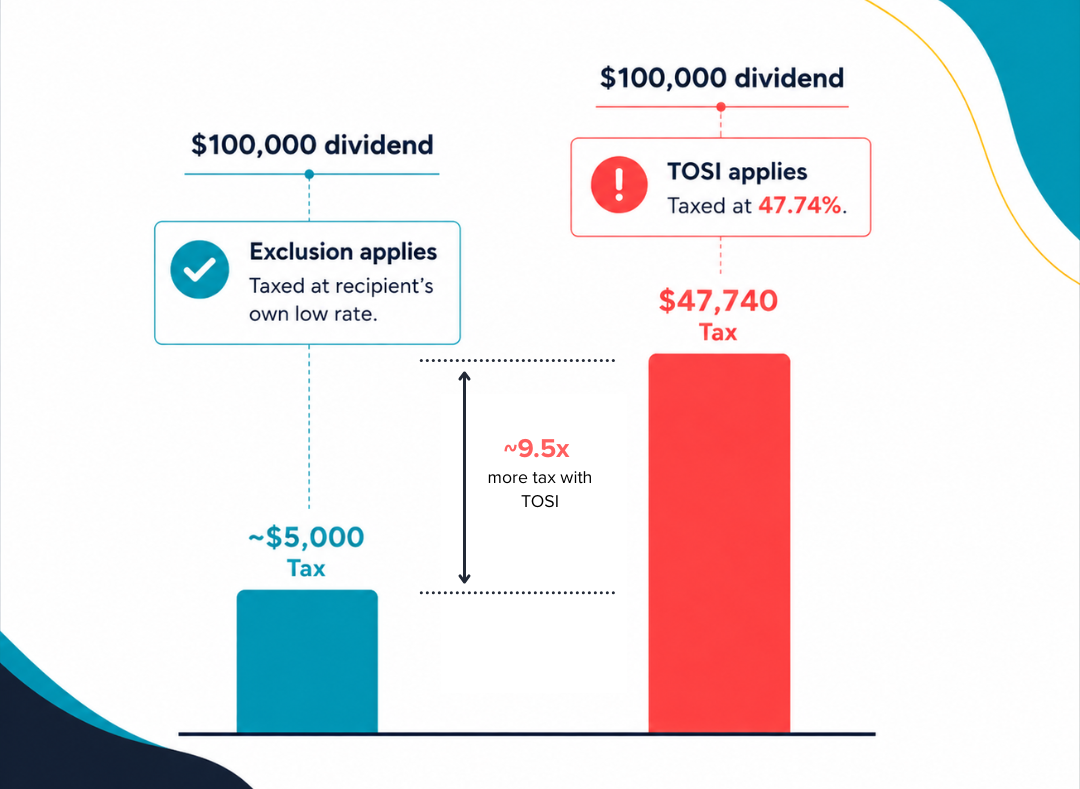
As an example, assume $100,000 of non-eligible dividends is directed to a family member. If a valid exclusion applies and that person has little other income, the dividends are taxed at their own graduated rates, and much of the amount falls in the lowest brackets. If TOSI applies instead, the same $100,000 is taxed at 47.74%, roughly $47,740, no matter how low the recipient's other income is. The gap between those two outcomes is the entire value that income sprinkling used to deliver, and the entire amount TOSI is designed to claw back.
Which exclusions keep income out of TOSI?
An amount that would otherwise be split income is an "excluded amount" (and fall outside TOSI) if it fits one of several exceptions. The exceptions available depend heavily on the recipient's age, as illustrated below.
Note: Salary for genuine work is not in this table because it is never split income in the first place. It sits entirely outside TOSI at any age.
Each of the main adult exceptions is worth understanding on its own.
What is the “excluded business” exception?
The “excluded business” exception applies to a family member who is genuinely working in the business. An adult is treated as "actively engaged" if they work in the business an average of at least 20 hours per week during the part of the year the business operates, either in the current year or in any five prior years.
Two features make this exception relevant to many shareholder families. First, the five prior years do not need to be consecutive. Second, once someone has met the 20-hour test in any five years, they are generally grandfathered on that business for life. For example, a spouse who worked full-time in the company for its first five years, then stepped back to raise a family, can continue to receive dividends free of TOSI on that business, even in years they do no work at all.
The practical requirement is documentation. If the CRA asks whether a family member met the 20-hour average, the answer needs to be supported by something more durable than memory. Contemporaneous records, calendars, or a simple time log make the difference between a defensible position and an assessment.
What are “excluded shares”?
In contrast to the above, the “excluded shares” exception is the one that does not require any work at all. It is a bright-line ownership test, and for adults aged 25 or older it can be the cleanest way out of TOSI. Shares qualify as excluded shares when all of the following are true:
- The individual is 25 or older in the year.
- The individual directly owns shares giving them 10% or more of both the votes and the value of the corporation.
- Less than 90% of the corporation's business income comes from providing services, and the corporation is not a professional corporation.
- Substantially all of the corporation's income does not come from another related business of the individual, other than the corporation's own business.
There are several common misconceptions related to these conditions:
- The ownership must be direct. Shares held for a family member through a discretionary family trust, a very common structure, do not qualify as excluded shares.
- The corporation must not be a service business, which shuts this exception for consultancies, agencies, and similar operations where 90% or more of income comes from services.
- Professional corporations (medicine, law, accounting, and the like) are excluded outright, which is why professional practices usually have to rely on the excluded business or reasonable return routes instead.
For product businesses, e-commerce, and many software companies where a spouse holds a real 10%-plus direct stake, “excluded shares” can be the simplest and most durable protection available. Whether a given business counts as a "service" business is not always obvious, and is worth confirming rather than assuming.
What is a “reasonable return”?
When neither excluded business nor excluded shares is available, an adult aged 25 or older can still fall outside TOSI if the amount they receive is a "reasonable return." In this regard, there is unfortunately no formula or bright line test. Instead, the CRA weighs the amount against what the individual actually contributed, across four factors:
- Labour: the work they performed in support of the business.
- Capital: the property or funds they contributed.
- Risk: the liabilities they took on, including guarantees on loans or lines of credit.
- History: the amounts already paid to them for their involvement.
The CRA has said it will not generally challenge a figure where the taxpayer made a good-faith attempt to set a reasonable amount using these factors. That good-faith standard cuts both ways: It gives room to compensate a family member who contributes in ways that do not fit the 20-hour test, such as a spouse who personally guarantees the company's credit line. It also means the burden is on you to show your work. “Reasonable return” is a flexible exception and the least certain, which makes documentation paramount.
How TOSI treats family members aged 18 to 24
Adults in this age band get a narrower set of options. They can use the excluded business exception if they meet the 20-hour test. Beyond that, they are generally limited to a return on capital they personally contributed to the business, either a "safe harbour" return capped by a prescribed-rate formula, or a reasonable return based only on arm's length capital they put in. They cannot use the excluded shares exception, and they cannot claim a reasonable return based on labour the way someone 25 or older can. In practice, dividends to an 18-to-24-year-old who is not genuinely working in the business are usually caught.
Does TOSI still allow income splitting after age 65?
Yes, in a specific and useful way. The rules include an exception that mirrors pension income splitting. If an amount would be an excluded amount for a business owner who is 65 or older, that same amount can be excluded when it is received by their spouse or common-law partner, even if the spouse has no independent claim to an exception.
The practical effect is that a business owner aged 65 or older who holds qualifying shares can split dividend income with a spouse without TOSI applying, much as they could split pension income. This makes retirement-stage share ownership worth planning deliberately, because getting the ownership right on the 65-plus spouse's side is what opens the exception for the household.
TOSI and capital gains
Certain taxable capital gains on private company shares are split income and can be caught by TOSI. There is an important carve-out: taxable capital gains from the disposition of “qualified small business corporation shares” (QSBC) and “qualified farm or fishing property” (QFFP) are excluded amounts for any individual at any age. This preserves the lifetime capital gains exemption (LCGE) planning that many owners rely on when selling or transitioning a business.
How can business owners plan around TOSI?
Substance greatly matters in TOSI planning. Every durable planning move comes down to making a family member's involvement real, and then documenting it. The levers below are the ones that come up most often.
None of these are shortcuts. They are ways of aligning how you pay people with what those people actually do, which is exactly what the rules are built to reward. This is the point where structure, compensation, and documentation need to be looked at together rather than one at a time, and where ongoing financial oversight tends to pay for itself, because a TOSI problem discovered at year-end is far more expensive to fix than one designed around in advance.
The most common TOSI mistakes
The errors we see fall into a short list, and they are almost all preventable.
Assuming a family trust protects the “excluded shares” exception. Unfortunately, it does not. “Excluded shares” must be held directly. Owners frequently believe a spouse "owns 25% of the company" when, in fact, those shares sit in a discretionary trust, which means the exception is off the table and a different route is needed.
Treating a service business like a product business. Consultancies, agencies, and professional corporations cannot use the “excluded shares” exception. Owners in these businesses who rely on that exception without checking the 90% services test can be caught by surprise.
Paying dividends to an adult child at university who does not work in the business. This is the textbook case TOSI was written for. An 18-to-24-year-old who is not genuinely working the hours will usually be taxed at the top rate on those dividends.
Failing to document the 20-hour test. The exception is real, but it lives or dies on evidence. Without records, a genuinely engaged spouse can lose an exception they legitimately qualified for.
Setting a "reasonable return" with no basis. Picking a number that feels fair, with nothing tying it to labour, capital, or risk, invites reassessment. The exception is available, but only to those who can show their reasoning.
When to bring in a tax advisor
TOSI is fact-specific in a way that resists rules of thumb, and the cost of getting it wrong is measured in top-rate tax plus interest. A few situations warrant a professional review rather than a best guess:
- You pay dividends to a spouse, child, parent, or sibling and are not certain which exception, if any, applies.
- Your shares are held through a family trust, and you have been relying on the “excluded shares” exception.
- Your business is in services or is a professional corporation, and family members receive dividends.
- You are approaching 65 and want to structure retirement income splitting correctly.
- You are planning a sale, a freeze, or a succession that involves qualifying capital gains.
The bottom line
TOSI did not make it illegal to pay family members from your business; rather, it made it necessary to pay them for a legitimate reason. Work, ownership, and risk all still count, and the exceptions are generous to people who genuinely contribute. What no longer works is directing arbitrary amounts of income to a family member purely because they sit in a lower bracket.
The owners who navigate this well are not the ones with the most aggressive structures. They are the ones whose compensation reflects reality and whose records prove it. Get the substance right, document it as you go, and TOSI becomes a rule you plan around rather than a bill you receive.
Key takeaways
- TOSI taxes sprinkled income at the top rate. Since 2018, it applies to adult family members, not just minors. In Ontario, caught non-eligible dividends are taxed at 47.74% regardless of the recipient's bracket.
- Salary is never split income. Paying a family member a reasonable amount for real work is outside TOSI entirely.
- The exceptions are the strategy. “Excluded business” (the 20-hour test), “excluded shares” (10%+ direct ownership for those 25 and up), and “reasonable return” are the three routes most private companies use.
- “Excluded shares” have hard limits. They must be held directly, not through a trust, and they are unavailable to service businesses and professional corporations.
- Documentation decides close cases. The 20-hour test and reasonable return both depend on records made at the time, not reconstructed under audit.
- Age matters. The 18-to-24 band is narrow, and a dedicated exception at 65 allows retirement income splitting with a spouse.
Frequently asked questions
Q: Can I still pay dividends to my spouse without TOSI applying?
Often, yes, if an exception applies. The most common routes are the “excluded business” exception (your spouse works an average of 20 or more hours per week, in the current year or any five prior years), the “excluded shares” exception (your spouse is 25 or older and directly owns at least 10% of the votes and value of a non-service, non-professional corporation), or a documented “reasonable return”.
Q: Do shares held through a family trust qualify for the “excluded shares” exception?
No. The “excluded shares” exception requires the individual to own the shares directly. Shares held for a family member through a discretionary trust do not qualify, which is a frequent and expensive misunderstanding.
Q: How is TOSI calculated?
Income caught by TOSI is taxed at the top combined federal and provincial marginal rate for that type of income. For an Ontario recipient in 2026, that is 53.53% on ordinary income and interest, 47.74% on non-eligible dividends, 39.34% on eligible dividends, and 26.76% on capital gains. Most personal credits cannot reduce TOSI, although the dividend tax credit, foreign tax credit, and disability tax credit are preserved.
Q: Does TOSI apply to income splitting after age 65?
There is a specific exception. If an amount would be an excluded amount for a business owner who is 65 or older, it can also be excluded when received by their spouse or common-law partner. This mirrors pension income splitting and allows deliberate retirement-stage planning.
Q: Are business sales affected by TOSI?
Taxable capital gains from the disposition of qualified small business corporation shares and qualified farm or fishing property are excluded amounts for any individual, so they are not caught by TOSI. This preserves lifetime capital gains exemption (LCGE) planning on a sale or succession.
TOSI is one of those rules where the cost of a wrong assumption is measured in top-rate tax. If you pay dividends to family members and are not certain your structure holds up, we can review it before the CRA does. ConnectCPA provides tax and controllership support for Canadian businesses. Book a call to learn more about our services.
