

.png)
Not a sponsored post
We’ve never been ones to follow the traditional route just for the sake of it. When it came time to move away from our old CRM and job management tool, we didn’t look for the next most popular accounting platform. We looked for the right one - one that would adapt to the way we work, not the other way around.
In this article, we consulted our Head of Data, Adam Doogan-Smith, who built our Airtable ecosystem from scratch. We picked his brain to understand the thinking, structure, and philosophy behind the move, and what it reveals about how we approach technology at ConnectCPA.
While most accounting firms would’ve gone with industry-standard practice management tools built specifically for accountants, we made a deliberate pivot. We chose Airtable.
And here’s why.
Our Old CRM Had Run Its Course
By early 2023, it was clear that our old system (despite being central to our workflows for years) had reached its end-of-life for ConnectCPA. As Adam put it: “It simply felt like a legacy product. There were no improvements, no new features. It wasn’t evolving with us.”
Evaluations followed. Various platforms entered the discussion. But ultimately, Airtable emerged as the platform with the right balance of structure and flexibility, and most importantly, a familiar interface that made the transition easier.
"Airtable felt like a more powerful version of what we had before, with the freedom to build anything we wanted, instead of adapting to how other software thinks we should work."
We Wanted to Build Systems Our Way
While many off-the-shelf platforms might offer sleek dashboards or ready-made workflows, we found they often force you into their way of thinking. That just doesn’t work for a firm like ours, with eight years of carefully crafted automations, layered data relationships, and custom workflows across departments.
"One of the biggest issues in our old CRM was the difficulty of analyzing data across entities in a corporate group. With Airtable, we restructured the data model from the ground up to remove those roadblocks."
One of the major backend upgrades was how we handled data modeling. Previously, trying to see the full picture across service lines or a complex asset hierarchy often felt clunky. In Airtable, Adam was able to build a structurally sound model that lets us blend data from different areas of the business cleanly and accurately. This unlocked new ways of working faster and smarter.
Another key improvement was how we approached job management. In our old system, a job only rolled forward once it was marked as completed. If a task fell behind, the next job might never get created. Airtable allowed us to automate a daily check that identifies any overdue, incomplete jobs and auto-generates the next cycle, ensuring continuity and no missed steps.
Airtable Gave Us Visibility We Didn’t Have Before
We didn’t want to simply replicate our old workflows; we wanted to upgrade them.
We now push client-level profitability metrics into Airtable, allowing team members to view financial performance across corporate groups instantly. What used to take management 10–15 minutes of digging now takes just a few keystrokes in a custom-built interface.
From an operational perspective, this migration was an opportunity to evaluate everything. Our legacy platform had built up nearly a decade’s worth of automations, many of which were no longer functional or relevant. Airtable gave us the chance to rebuild only what mattered, cleanly and intentionally. Data inputs are now more standardized, either through automation or structured intake forms which reduces errors and manual intervention.
According to our VP of Operations, Tom Son, one of the biggest advantages of Airtable is its familiar, spreadsheet-like format, which makes it easy to sort, view, and edit data. This allows the team to navigate through the job center with minimal clicks and quickly access past, current, and upcoming jobs.
“Due to its ease of use, it saves our team a lot of time in regards to job management and documentation.”
Tom also emphasized the impact of Airtable’s API:
“We’re now able to do things we only imagined a few years ago. Integrating our time tracking platform into the job centre to compare budget vs. actual labour has been a game changer. Calculating departmental and client profitability has become easy and automated.”
Even seemingly small improvements like being able to edit job descriptions directly from the overview page have made a big difference in reducing unnecessary clicks and keeping the team in flow.
"We used the migration to clean house. We got rid of 'dead batteries' and rebuilt smarter."
Have You Ever Had a “How Did We Live Without This” Moment?
Absolutely.
While our old CRM got the job done, it was slow, outdated, and no longer matched the scale of our operations. “Our practice outgrew its ideal usage,” Tom explains. “After moving to Airtable, the speed improvement was instantly noticeable. It made our daily experience smoother and more enjoyable.”
What really shifted the game, though, was the power of Airtable’s API.
“Integrating time tracking data, generating detailed operational reports, and automating processes like signature sign-offs and deliverables have been game changers.”
AI Surprise
We knew Airtable would eventually offer AI tools within their platform but we didn’t expect it to happen this fast.
Their new AI assistant, Omni, is built right into the platform and allows us to ask questions about anything in our CRM. It returns contextual, intelligent answers in seconds - no digging through tabs or linked records required.
For a firm managing thousands of interconnected records, that kind of accessibility makes a real difference. From pulling job history to spotting delays or surfacing trends, it helps our team get the answers they need at an instant.
And because our data is already structured intentionally, we’re in a strong position to take full advantage of AI tools as they continue to roll out without having to untangle years of legacy systems to get there.
It Reflects How We Think as a Firm
Choosing Airtable over traditional platforms was a deliberate decision. It was a statement about us.
We’re a data-first, tech-forward firm that believes in building systems around our people and processes - not forcing those processes into someone else’s mold.
For years, we’ve had talented data professionals design tools that empower our team to work faster, smarter, and with more visibility. As Adam puts it:
"It’s not the tool you use, it’s how you use it."
Advice for Firms Considering a Similar Move
If you're stuck with rigid software and wondering whether there's a better way, Adam offers this:
"Understand the roadblocks. Lean on your peers and the resources around you. And ask yourself: do you have the time to take one step back, if it means two steps forward?"
One Last Nerdy Note
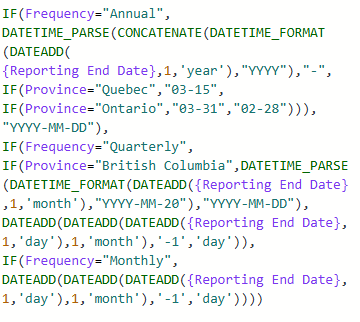
We’ll leave you with one of Adam’s favorite (and most complex) Airtable formulas: a due date calculation that factors in province, reporting frequency, and filing end date. It’s built specifically for WSIB filings.
If you're curious about how we’ve built a modern accounting practice that thinks like a tech company - get in touch. We'd be happy to show you how we do things differently.
Related: The Data Journey at ConnectCPA
