

Two years ago, you could trip up AI tools on Canadian tax without really trying. Ask about a rule that had changed recently and you would get a fluent, confident, completely wrong answer.
Try it now. Ask a current tool how much of a capital gain is taxable in Canada and you will almost certainly get the right answer, half, along with an accurate account of the increase that was proposed in 2024 and cancelled in March 2025. Several tools will search to confirm before they answer. That is a real improvement, and it happened in about eighteen months.
The abilities that got dramatically better are the ones that were easy to measure and easy to correct: factual recall, arithmetic, drafting, summarizing. The ones that have barely moved are the ones nobody can benchmark, and those are precisely the ones that may reach your books or a client account.
That unevenness creates a specific trap for anyone running a business. You watch a tool do something impressive in a place where you can check its work, and you reasonably extend that trust to places where you cannot. The competence you saw was real but it doesn’t always translate perfectly.
It also means whatever rule of thumb your team landed on six months ago about what AI can be trusted with has probably changed. Somebody is still doing by hand the work these tools now handle well. Somebody else is relying on them for judgment they were never able to provide and still cannot.
So the useful question is not whether AI is good enough yet. That answer keeps moving, and it will keep moving faster than any policy you write about it. The better question is which tasks are safe by their nature rather than by the current state of the technology?
The question that actually separates safe AI use from expensive AI use
Most advice about AI in finance sorts tasks by difficulty. Simple tasks are safe, complex tasks are risky. That framing sounds reasonable and it is wrong often enough to be dangerous, because plenty of simple-sounding questions have expensive answers and plenty of complex tasks are perfectly safe to automate.
The better question is this: if the output is wrong, how long until you find out?
Ask a tool to rewrite a client email and you will know within three seconds whether it is any good, because you can read. Ask it to summarize a 40-page contract and you will catch a bad summary the moment you check it against the document. The feedback loop is immediate and the cost of an error is a redo.
Now ask it how to handle money you took out of the company and paid back, whether your first three US customers created a sales tax filing obligation, or whether a $60,000 software build counts as an asset you write off over years or a cost you deduct this year. You get an answer in the same tone, with the same structure, at the same speed. But you cannot evaluate this one, because if you could evaluate it you would not have needed to ask. The error surfaces at year end, in a lender's diligence request, or in a CRA review eighteen months later, by which point it is not one error. It is a pattern that has been repeating quietly in your books.
Efficiency gains come from the first category. False confidence comes from the second. The tool behaves identically in both, which is exactly why people do not notice they have crossed the line.
Where AI earns its place in a finance function
It is worth being clear that the skeptical half of this article is not an argument against the tools. Used inside their range, they are the biggest practical improvement to finance operations in a decade, and the firms pretending otherwise are not doing their clients any favours.
The pattern that holds across every good use case is that a human can verify the output faster than they could have produced it.
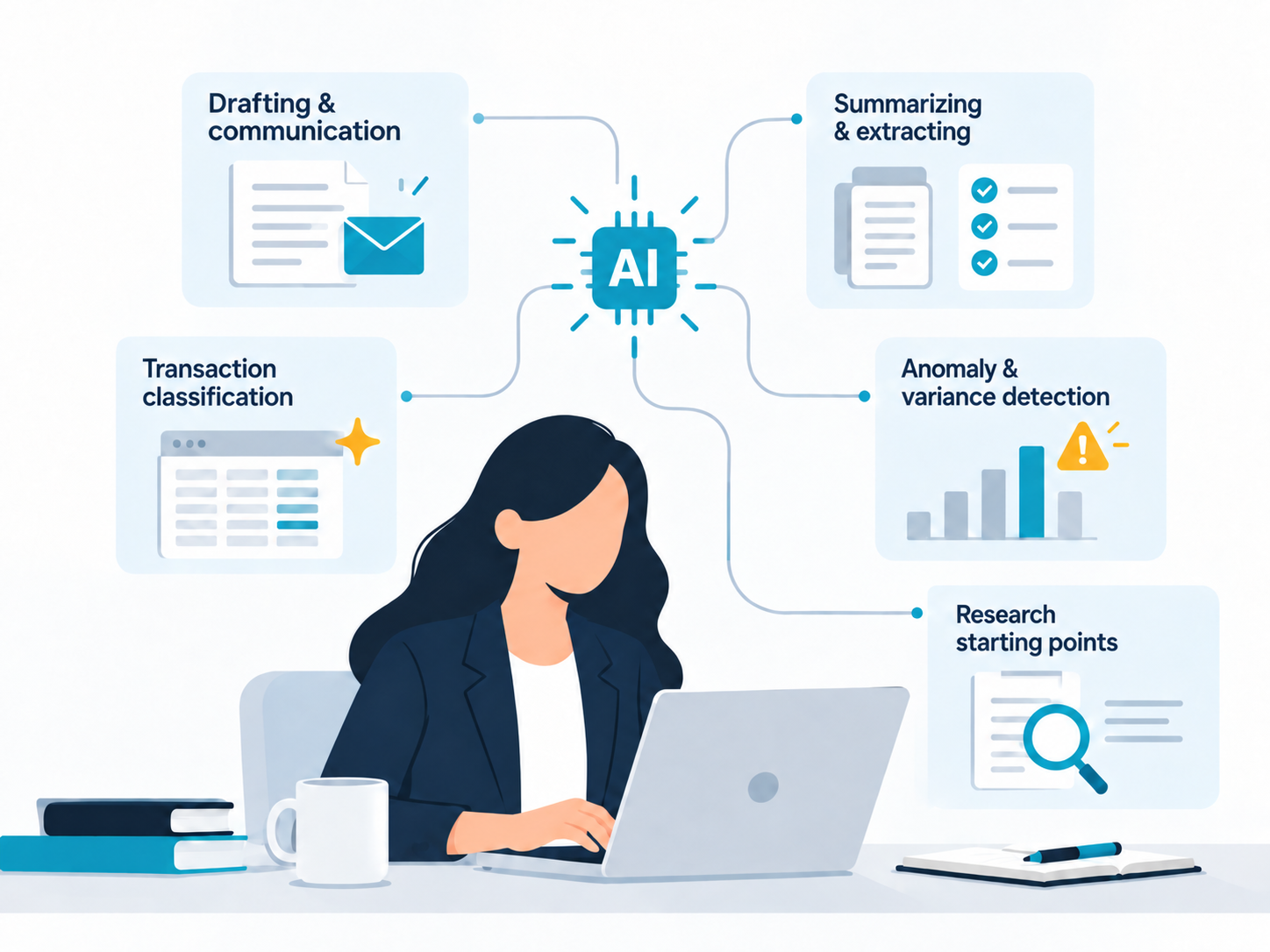
Drafting and communication. Collection emails, engagement scopes, policy write-ups, board memo first drafts, the explanatory notes that go alongside a monthly package. Nobody should be writing a fourth overdue-invoice email from scratch. You read the draft, you fix the tone, you send it.
Summarizing and extracting. Pulling payment terms and renewal dates out of a stack of vendor contracts, turning a 90-minute planning call into a structured set of action items, condensing a long CRA guidance page into something a non-accountant can act on. The source document is right there, so checking is cheap.
First-pass transaction classification. Bank feed rules and AI-assisted coding genuinely reduce the grind of a monthly close, provided someone reviews the exceptions rather than the whole population. The value is in narrowing 900 transactions down to the 40 that need a human.
Anomaly and variance detection. This is the most underrated use and the one closest to actual controllership. Asking a model to compare this month's numbers against the last twelve and flag anything out of pattern will surface things a person skimming a report will miss. It will produce false positives. That is fine, because a false positive costs you two minutes and a missed variance costs you a quarter.
Research starting points. Getting oriented on an unfamiliar topic, generating the list of questions you should be asking, finding the name of the rule so you can go read the actual rule. The output is a map, not a destination.
Notice what every one of these has in common. The AI produces a draft, a shortlist, or a starting point. A person still makes the decision, and that person can check the work quickly. None of them end with the model deciding something that lands on a tax return.
Where false confidence shows up
Here is where the same tools stop being useful and start being expensive. These are the patterns worth recognizing, because none of them look like errors when they happen.
It answers a Canadian question with American rules
This is the failure mode Canadian businesses run into most, and almost nobody warns about it.
General-purpose models are trained on material that is overwhelmingly American. Give one a short question with no country attached and the default answer leans American, with nothing in the response to tell you which country it came from. The vocabulary is close enough that the substitution is invisible to anyone who is not already an expert.
The tools have improved here too, and a detailed question that mentions Canada will usually get a Canadian answer. The risk lives in the short question typed quickly, which is how most people actually use them.
Vehicles are the cleanest illustration, and a common enough question that most owners ask it eventually. Ask an AI tool how much of a $78,000 SUV your company can write off and you will often get an answer describing a first-year deduction close to the full purchase price. That is an American answer. Canadian rules cap what you can ever write off at $39,000 before tax for a vehicle bought in 2026, and spread even that over several years rather than giving it to you at once. Everything above the cap is never deductible at all. Electric vehicles get a higher cap of $61,000. Lease rather than buy and the deduction is capped at $1,100 a month before tax, with car loan interest capped at $350 a month. An owner planning around the American answer is planning around a deduction more than twice the size of the one actually available, and will usually find out at year end.
There is a useful tell buried in this one. If an answer about writing off vehicles or equipment mentions Section 179 or bonus depreciation, you are reading American tax rules. Neither of those exists in Canada, and their appearance is a reliable signal that the rest of the answer came from the wrong country too.
The same pattern shows up in several other places:
Company structure. Ask a model what kind of company to set up and it will frequently suggest an LLC. That is an American structure. Canada does not have it, and a Canadian who sets one up in the US can land in the worst available position, where the two countries disagree about what the company even is, the mechanism that normally stops you being taxed twice stops working, and the same income gets taxed on both sides of the border. This is the most expensive item on the list, and it arrives as casual advice.
Sales tax treated as a cost. In most US states, sales tax you pay on purchases is money gone, so it gets recorded as an expense. In Canada, the GST/HST you pay on business purchases is generally money you get back, claimed against the GST/HST you collect from customers. A model running on American logic will tell you to record it as a cost. Your expenses then look higher than they are, you leave recoverable tax sitting on the table, and nothing about the resulting P&L looks wrong.
Payroll. American deductions and American slips instead of CPP, EI and T4s. Usually obvious enough to catch, but it tells you where the rest of the answer came from.
Home office claims. Models still offer the American method based on square footage, or the simplified Canadian method that existed during the pandemic and was discontinued after the 2022 tax year.
If you take one habit away from this article, make it this one: state the country and the province in every finance question you ask an AI tool, and then treat the answer as a lead to verify rather than a conclusion.
It is confident about rules that have not actually settled
Settled rules are the easy case, and as noted above, the tools have got good at them. A rule that has been stable for a decade is well represented in the training data and easy to verify with a search.
The problem is rules that are genuinely in motion right now, where there is no settled answer to retrieve. A model cannot tell you that Parliament has not finished deciding something. It will give you the most confident-sounding version of whatever it found, which is usually a snapshot of one moment in an argument that is still running.
The reporting rules that apply when one person holds property on someone else's behalf are the live example, and they catch situations most owners would never think of as a trust. A parent added to title on a child's home. One company holding an asset for a related one. A lawyer holding funds for a client. That filing requirement has been introduced, suspended, brought back and rewritten more than once in the last three years, and the legislation setting out who is exempt was still in front of Parliament as this was written. Ask a model where it stands and you will get a clear answer. You will not get a reliable one, and the penalties for getting it wrong apply whether or not any tax was owed.
The pattern to watch for is anything that has been in the news as a proposal. Announced but not passed, passed but not in force, in force but under review, or reversed after people had already planned around it. Capital gains went through most of that sequence between 2024 and 2025. In that window, an owner asking an AI tool whether to accelerate a share sale before year-end would have received a clear, well-reasoned and urgent recommendation built on a tax increase that no longer existed. The tools have caught up on that particular question. They have not caught up on the next one, because it has not finished happening yet.
The related failure here is invented authority. Models fabricate section numbers, form numbers and government guidance references, and they produce them in exactly the format a real citation takes. A made-up source is more dangerous than no source, because it makes an unverified answer feel checked. If an AI tool gives you a citation, that citation is the first thing to verify, not the thing that settles the question.
It codes a transaction plausibly, and then the error multiplies
Nobody makes a single AI coding error. That is the part people miss.
Consider a Vancouver e-commerce business running about $5M through Shopify and a US marketplace. The bookkeeper uses an AI-assisted categorization feature to speed up the monthly close. The tool sees a recurring $4,200 deposit with a payment-processor descriptor and codes it to sales revenue. Reasonable on its face. The deposit is actually a net settlement, already reduced by processing fees, refunds and chargebacks.
Nothing about this looks broken. The bank reconciliation still balances, because the cash is real. Revenue is understated by the fees, the fees never appear as an expense, and gross margin is wrong in a way that looks stable and therefore credible. Then someone accepts the classification, builds a bank rule around it, and the same treatment applies automatically to every settlement for the next fourteen months.
The same shape of error shows up repeatedly:
A loan drawdown, an intercompany transfer, a GST/HST refund and a customer deposit all look like revenue to a tool reading a bank line. Revenue is overstated, and so is the tax bill, until somebody unwinds it.
Owner draws get coded to salary or to a general expense instead of being tracked as shareholder loan activity. That one does not stay an accounting problem. It becomes a tax problem, and shareholder loan accounts become a tax problem faster than most owners expect.
A software build or an office renovation that should have been recorded as an asset and written off over several years gets expensed all at once, because the invoice description read like a running cost.
The lesson is not that AI classification is bad. It is that AI errors scale exactly as efficiently as correct treatment does. Automation multiplies whatever you give it, and a plausible-looking error that becomes a rule is the most expensive kind, because it is now producing wrong entries without anyone making a decision.
Document capture reads the wrong number, in the right format
Receipt and invoice capture is the AI feature most businesses already have switched on and do not think of as AI. It is also where the least glamorous errors live.
Extraction tools misread the subtotal as the total, pick up the tip line, read a US dollar amount as Canadian, or pull the invoice date from a payment stamp. Each one produces a tidy, structured, entirely wrong record.
The one that costs real money is sales tax. A capture tool will confidently pull a GST/HST amount off a receipt that is missing the supplier's registration number. The amount looks right, the claim goes through, and it will not survive a review, because the CRA is specific about what has to appear on a receipt before you are allowed to claim the tax back on it. The documentation standard that actually holds up is stricter than most businesses assume, and a tidy extracted number is not the same as a valid claim.
Duplicates are the other one. Capture the supplier invoice, then capture the credit card receipt for the same purchase, and you have booked the cost twice. Expenses are overstated, margin is understated, and both documents are genuine, which is why nothing gets flagged.
The analysis is arithmetically perfect and conceptually wrong
This is the failure mode that most directly affects decisions, because it happens at the level founders actually operate at.
Upload a P&L, ask how the business is doing, and you will get a competent answer. Margins calculated correctly. Growth rates right. Trends identified. The arithmetic will be flawless, because arithmetic is the easy part.
What the model cannot know is whether the underlying classification is sound. Take a professional services firm at $4M with subcontractor costs sitting in operating expenses rather than cost of sales. The AI reports a gross margin of 71% and notes that it has improved four points year over year. Both statements are true about the data and false about the business. The real gross margin is closer to 44%, and the four-point improvement is not margin expansion at all. It is the result of someone recoding an account in March.
For a SaaS company the equivalent is revenue recognized on billing rather than earned. A model reading that P&L will describe a growth curve that is really a billing-timing curve, which is the exact problem tracking deferred revenue properly exists to solve. It will also compare a month with three payroll runs to a month with two and report a cost increase that never happened, which is one of several ordinary reasons your P&L changes month to month.
An AI analysis is only as good as the chart of accounts underneath it, and it has no way to tell you that the chart of accounts is the problem. It will simply analyze what it was given, fluently.
It will change its answer if you push back. The CRA will not.
This is the cleanest demonstration of false confidence available, and you can run it yourself in about ninety seconds.
Ask an AI tool a tax question and note the answer. Then reply, "Are you sure? I thought that was deductible." Watch how often it softens, hedges, or reverses. Try the same experiment in the opposite direction and watch it reverse again.
This is not a bug you can prompt your way around. These systems are built to be agreeable, and agreeableness is indistinguishable from confirmation when you are the one asking. If you go in hoping something is deductible, you can usually get there.
The practical consequence is simple. Agreement from an AI tool is not evidence. It tells you the answer was plausible, which is a much lower standard than correct, and a standard the CRA does not recognize.
The test to apply before you rely on an AI answer
Sort the task, not the tool. One question does most of the work.
The line is not about how hard the question is. It is about how long an error survives undetected, and how many transactions it touches while it does.
Three habits follow from this, and they cost almost nothing to adopt.
Say where you are, every time. Opening the question with "in Canada, in Ontario, for an incorporated business" changes the answer materially. Leaving it out is how you end up with American rules.
Never let an AI suggestion become an automatic rule without a person signing off on how it should be recorded. The suggestion is a starting point. Turning it into a rule is a policy decision, and policy decisions deserve a higher bar.
Treat citations as the first thing to verify, not the thing that ends the discussion. If a model names a section, go read the section.
What this looks like when it is working
The firms and finance teams getting real value from these tools are not the ones using them most aggressively. They are the ones who have been deliberate about where the human sits in the process.
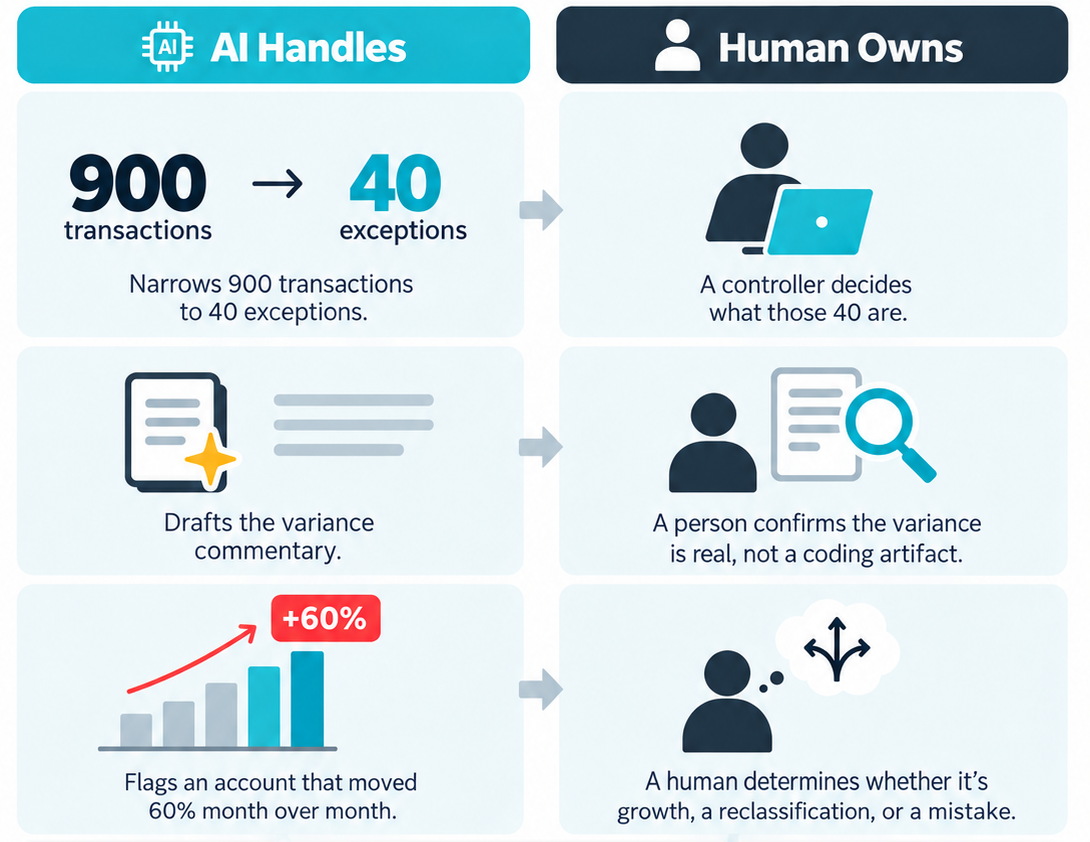
In practice, that means AI handles volume and pattern recognition, and a person owns judgment and treatment. The tool narrows 900 transactions to 40 exceptions; a controller decides what those 40 are. The tool drafts the variance commentary; a person confirms the variance is real and not a coding artifact. The tool flags that an account moved 60% month over month; a human works out whether that is growth, a reclassification, or a mistake.
That division of labour is also why the accounting system matters more in an AI-assisted process, not less. Every one of the failure modes above gets worse when the underlying structure is weak, because AI accelerates whatever is already there. A clean chart of accounts, consistent classification policies, and reconciliations treated as a control rather than a checklist are what make automation safe to lean on. Without them, faster processing just means arriving at the wrong number sooner.
This is also the honest version of what "tech-driven, human-led" means, and why human-led accounting still wins in a tech-heavy world. Not because the technology is unreliable, but because somebody has to own the part the technology cannot: deciding whether the output is actually true.
The cost of getting this wrong is a timing problem
Every failure mode in this article is reversible for a while, and then it is not.
A misclassified transaction is a two-minute fix in the month it happens. It is a restatement conversation after it has been running for a year. A vehicle deduction planned on American rules is a conversation before you buy. It is a surprise on a return afterward. A share sale timed against a cancelled tax rule is a decision you cannot take back.
What makes these expensive is not the error itself. It is the months between the error and the discovery, and AI tools compress the time it takes to make the error while doing nothing at all to shorten the time it takes to find it.
If you are running a business past $2M without a controller or CFO, and your team is using AI tools in the finance function, the useful question is not whether to allow it. That decision has already been made for you by whoever is already using them. The question is which decisions currently have no human check on them, and whether anyone would notice if one of those decisions were wrong.
That is the review worth doing this quarter, and it takes an afternoon. Pull the transactions coded by rule rather than by a person. Check the three or four accounts where classification is a judgment call rather than a description. Ask your team what they have been asking AI tools about, and whether anyone verified the answers.
You will probably find that most of it is fine. The point is to know which part is not.
Frequently Asked Questions
Is it safe to use AI for bookkeeping in Canada?
It is safe for tasks where an error would be visible quickly, such as drafting, summarizing, first-pass transaction categorization with human review, and flagging unusual variances. It is not safe for tasks where an error stays hidden until year end or a CRA review, such as how something gets taxed, whether a purchase counts as an asset or an expense, sales tax decisions, and anything that turns into an automated rule. The dividing line is how fast you would catch a mistake, not how hard the task is.
Why do AI tools give wrong answers about Canadian tax?
General-purpose models are trained on material that is overwhelmingly American, so a tax question that does not name a country tends to get an American answer. You will see American write-off rules like Section 179 and bonus depreciation instead of the Canadian system, American payroll deductions instead of CPP and EI, and sales tax treated as money gone rather than as GST/HST you can claim back. The vocabulary is similar enough that the swap is hard to spot. Always state the country and province in the question, and check the answer against a Canadian source.
Can ChatGPT tell me how much of a vehicle purchase I can write off?
It will give you an answer, and for a Canadian business that answer is frequently built on American rules. In Canada there is a cap on how much of a passenger vehicle's cost you can write off at all. For a vehicle bought on or after January 1, 2026, that cap is $39,000 before tax, or $61,000 for an electric vehicle, and it is claimed over several years rather than all at once. Anything you spend above the cap is never deductible. If you lease, the deduction is capped at $1,100 a month before tax, and car loan interest at $350 a month. Writing off the whole cost of a large vehicle in the first year is an American concept, not a Canadian one.
How much of a capital gain is taxable in Canada right now?
Half of it. That share, which the rules call the inclusion rate, has been one-half for years. The proposed increase to two-thirds was announced in 2024, deferred in January 2025, and cancelled outright on March 21, 2025. Separately, the amount that can be taken tax-free on the sale of shares in a qualifying small business was raised to $1,250,000. Worth noting for anyone relying on AI tools: through 2024 and into 2025 this question produced confidently wrong answers, because the rule changed three times while it was being asked. It answers correctly now that the rule has settled. The caution applies to whatever is currently unsettled, not to this.
How do I know if an AI tool has made a mistake in my books?
The errors that matter rarely look like errors. The reconciliation still balances, the report still formats correctly, and the totals still tie. Look instead at the places where recording something is a judgment call rather than a description: what counts as cost of sales versus overhead, whether a purchase is an asset or an expense, how money taken out by owners is recorded, transactions between related companies, and anything involving sales tax. Then check whether any AI classification has been converted into an automated rule, because a rule turns one bad decision into hundreds of bad entries.
Should my accountant be using AI?
Yes, for the work where it improves speed and consistency without removing judgment. What matters is what sits around it. Ask any firm you work with which parts of their process use AI, what the review step is, and who signs off on treatment decisions. A firm that cannot answer that clearly either is not using the tools or is not controlling them.
