

The half of your GST/HST return you stopped thinking about is the half the CRA scrutinizes most. Here is the documentation standard, what trips businesses up, and a checklist you can run against your own books.
If you collect GST/HST and remit it on time, you have handled the easy half. Charge the tax, hold it, send it to the CRA. The mechanics are simple and most businesses get them right.
The line the CRA actually scrutinizes sits on the other side of the return: your input tax credits. ITCs are where the documentation standard is specific, where the rules are easy to get subtly wrong, and where most businesses are sloppy without realizing it.
You'd be surprised how often we see this. A business owner is confident about the remittance side, has never had a problem, and assumes that confidence covers the whole return. It does not. The remittance side is money you are sending the government. The ITC side is money you are taking back. The CRA pays much closer attention to the second.
What the documentation standard actually says
The rules live in subsection 169(4) of the Excise Tax Act and the Input Tax Credit Information (GST/HST) Regulations. They set out exactly what information you need to hold before you claim an ITC, and the requirement scales with the size of the purchase.
One thing worth flagging up front, because a lot of older guidance (and a lot of bookkeepers) still has the wrong numbers: the thresholds were raised effective April 20, 2021. They used to be $30 and $150. They are now $100 and $500. The figures refer to the total amount including tax, not the pre-tax subtotal.
Here is the current standard, by purchase size:
Two practical notes. First, the information does not all have to live on a single piece of paper. A receipt, an invoice, a contract, and your own internal records can be read together. The CRA's own position is that the supplier's registration number does not strictly have to appear on the invoice, and gaps in a supplier's paperwork can be filled by your records.
Second, that flexibility has limits. The number you rely on has to be valid. One of the most common reasons the CRA disallows an ITC on review is that the supplier's name does not match the registration number on file, or the supplier was not actually registered when they charged you.
So the real test is not "is the number printed on the receipt." It is "can I prove, with what I hold, that I paid GST/HST to a registered supplier for a commercial purchase." If you can, the claim survives. If you cannot, it does not, and the legitimacy of the underlying expense will not save it.
The gap that bites most often
Now that small receipts under $100 need no registration number, the cafe-receipt problem has mostly solved itself. A $6 coffee does not require a supplier number, so claiming the ITC on it is no longer a documentation failure (assuming you are even claiming it, which for most businesses is rounding error).
The exposure moved up the dollar scale. The gap that actually generates assessments now is the $100-to-$500 invoice with no supplier registration number, and the $500-plus invoice missing a description or the recipient's name. These are the amounts large enough to add up and common enough to slip through: subcontractor invoices, supplier bills, professional services, software renewals billed annually.
The pattern we see in cleanup work is rarely one large bad claim. It is a steady drip of mid-sized invoices, each missing one required element, claimed month after month. Individually trivial. Across an open audit window, material.
In practice, the simplest way to stay on the right side of this is to capture the whole document, not just the total. If you upload the full vendor invoice to a receipt-capture tool like Dext (or the full bill for smaller purchases), you will have the supplier name, registration number, date, description and tax amount on file, which is what a review actually needs. A photo of a credit card slip will not do that.
The "you can't claim an ITC on this" list
A second category of exposure has nothing to do with paperwork. These are claims that fail because the expense itself does not qualify, no matter how clean the receipt.
The recurring ones:
- Personal expenses run through the corporation - If it is not a commercial-activity purchase, there is no ITC, and the attempt is a red flag in its own right.
- Meals and entertainment - You can claim the ITC, but section 236 requires you to recapture 50% of it, mirroring the 50% income-tax deductibility rule. The net result is half. Claiming the full amount is one of the most common ITC overclaims we correct.
- Club and membership dues - where the main purpose is recreation, dining, or sporting facilities.
- GST/HST paid to a non-registrant - If a supplier charges you tax but is not registered, that is not a valid ITC. It is the supplier's problem that becomes yours on audit.
- Insurance premiums - Insurance is an exempt financial service, so there is no GST/HST on the premium to claim in the first place. What you often see instead is a provincial tax, for example Ontario's 8% retail sales tax on certain insurance premiums and benefit plans. That is a provincial tax, not GST/HST, and it cannot be recovered as an ITC.
None of these are obscure. They show up in cleanup engagements constantly, usually because a card was used without a second set of eyes on the coding.
The cross-border trap
This one is worth its own section because it is growing and because it is genuine audit-trigger material.
There are actually 2 different cross-border mistakes here, and they pull in opposite directions.
The first is US sales tax.
A Canadian business with no US presence generally should not be charged US state or local sales tax at all. If it is showing up on your invoices, that is usually a billing error at the vendor's end, and the fix is to contact the vendor and have it corrected, not to try to recover it. It is not GST/HST, so there is no ITC on it either way.
The second is subtler, because it involves real Canadian tax.
Many large non-resident vendors (SaaS, app stores, streaming, ad platforms) are registered under Canada's simplified GST/HST regime for digital suppliers. Since 2023 the CRA has flagged these accounts with a registration number ending in RT9999, so a simplified registrant can be told apart from a regular one. Here is the part that catches business owners: GST/HST charged under the simplified regime cannot be claimed as an input tax credit. If you are registered for GST/HST, you are not supposed to be charged by these vendors in the first place. The fix is to give the vendor your GST/HST number so they stop charging you. If you have been paying it, that tax is money you are not getting back, so it is worth correcting sooner rather than later.
What genuinely is recoverable is the GST paid at the border when you import goods (Division III tax), provided you hold the import documentation to support it. The test the CRA applies is simple: was the tax you are recovering actually Canadian GST/HST charged by a supplier who can validly pass it to you. A US sales tax line fails that test. So does a simplified-regime RT9999 charge.
By contrast, a non-resident vendor on the normal regime carries an ordinary number ending in RT0001, and the GST/HST it charges is a valid ITC like any other. The identifier is what tells you which situation you are in.
Vehicles and home offices: allocation is documentation
Mixed-use assets create a quieter version of the same problem. A vehicle used for business and personal driving, or a home office, gives you a partial ITC based on the business-use percentage. The percentage is not the issue. The support for it is.
A "best guess" from your bookkeeper is not documentation. A mileage log is. A square-footage calculation is. Consistency year over year is. If your business-use percentage swings from 60% to 85% to 70% across three years with nothing behind the changes, you have handed an auditor an easy adjustment.
How far back the CRA can reach
Most business owners underestimate the window. Under section 298 of the Excise Tax Act, the CRA generally has about four years to reassess a GST/HST period. That alone is longer than many people assume.
It gets longer. Under subsection 298(4), the CRA can go beyond the normal period where there has been a misrepresentation attributable to neglect, carelessness, or wilful default, where there is fraud, or where you have signed a waiver. Sloppy ITC documentation, repeated across years, is exactly the kind of pattern that can be characterized as carelessness.
Keep this separate from a related four-year rule that often gets blended in: the window to claim an ITC is also roughly four years (two years for listed financial institutions and certain large registrants). One rule is how long the CRA has to come after a claim. The other is how long you have to make one. They are not the same rule, and you want both working in your favour.
Records, for what it is worth, have to be kept six years (section 286). The reassessment window and the retention requirement are also two different things.
Three ways a small ITC issue becomes a $20,000 problem
These are composite scenarios drawn from the patterns we see, not specific clients. The mechanics are real.
1. The subcontractor drip.
A services business claims ITCs on a year of subcontractor invoices. Several, totalling about $14,000 of ITCs, carry no verifiable registration number, and one subcontractor turns out never to have been registered. On audit, the CRA disallows the unsupported credits. Because the same coding ran for four years, the disallowance repeats. Add arrears interest compounding daily under section 280 and a penalty, and a paperwork habit clears $20,000.
2. The US software phantom.
An e-commerce business recovers roughly $3,500 a year in "tax" on US SaaS invoices that is actually US state sales tax. Over the open window that is about $14,000 of credits that never existed, plus interest. There was no underlying entitlement at all, which makes this harder to defend than a documentation gap.
3. Full-rate meals and a personal card.
A business owner runs meals and entertainment at the full ITC instead of recapturing 50%, and a handful of personal charges sit on the business card. Each year's adjustment is modest. Stacked across the reassessment window with interest, the cleanup and the assessment together land in five figures.
The 8-point audit-ready checklist
Run this against your last four quarters. It is the same standard we apply in a review.
- Supplier registration number is present and verifiable on every invoice of $100 or more, and recipient name plus a description appear at $500 or more.
- The ITC schedule reconciles to the general ledger. The number on the return ties to the books, with no unexplained difference.
- Meals and entertainment are flagged and recaptured at 50%, not claimed in full.
- Personal-use allocations are documented for vehicles and home office (mileage logs, square footage, consistent year over year).
- Capital purchases are tracked separately from operating expenses.
- US and other foreign purchases are flagged, with no ITCs claimed on non-Canadian tax or on simplified-regime (RT9999) charges.
- No plug entries in the GST/HST liability account. A forced balancing figure is a tell, and the CRA reads it as one.
- A quarterly self-review happens before filing, not a year-end scramble.

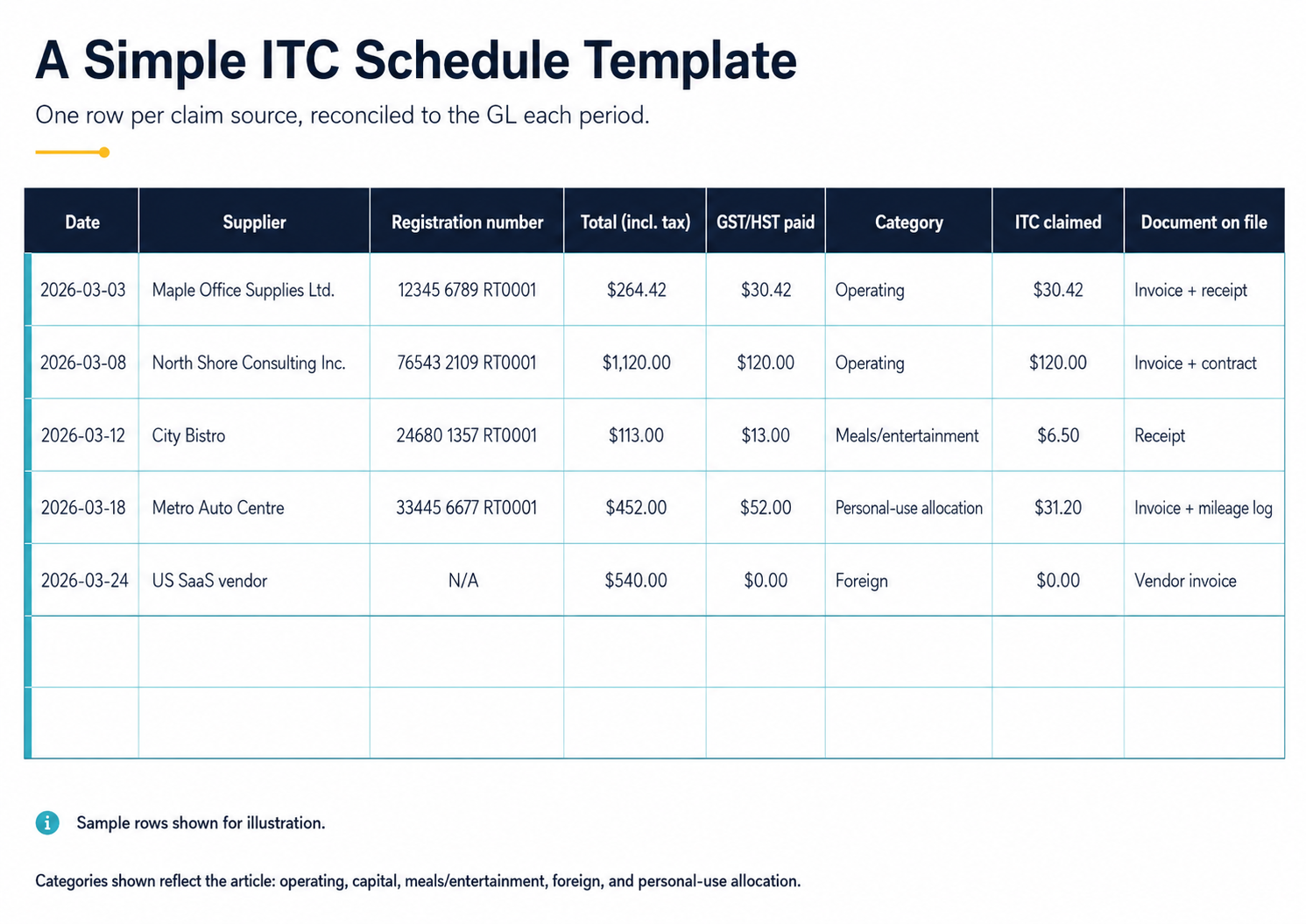
A simple ITC schedule template
If you do not already keep a working schedule behind your return, this is the minimum structure that makes a review fast and an audit calm. One row per claim source, reconciled to the GL each period.
Final thoughts
Collecting and remitting GST/HST is the visible, well-behaved half of the return. ITCs are the half that quietly carries the audit risk, because the standard is specific and the discipline tends to slip.
The exposure here is rarely dramatic. It is a documentation habit, a misread threshold, a US tax line treated as Canadian, repeated across an open window until it adds up. The fix is equally undramatic: a schedule that ties to the books, the right thresholds, and a quarterly look before you file.
If you have never had this checklist run against your last four quarters, you have unpriced exposure. Not panic-level, but worth knowing the size of.
If you want to know where your ITC exposure actually sits, we are happy to run this standard against your recent returns. ConnectCPA provides GST/HST and controllership support for Canadian businesses that would rather find the gaps before the CRA does. Let’s chat.
This article is provided for general information only and reflects the GST/HST rules and CRA administrative positions in effect as of July 2026. It is not tax, accounting, or legal advice, and it is not a substitute for advice specific to your situation. Thresholds, rules, and CRA positions change, and how they apply depends on your facts. Speak with a qualified advisor before acting on anything here.
