

Note: This article is provided for general educational purposes only and does not constitute US tax or legal advice. ConnectCPA is a Canadian accounting firm; we are not licensed to provide advice on US state and local tax law. State sales tax rules, thresholds, and product-taxability determinations change frequently and vary by state - always confirm current rules with a qualified US state and local tax (SALT) professional before making registration or filing decisions. Most Canadian SaaS businesses with US customers have heard the word "Wayfair" and assumed it doesn't apply to them. Here is when it does, what it actually costs, and what to do if you're already a few years behind.
A lot of business owners find out about US sales tax the same way: a state mails them a registration demand and a back-tax bill. By the time it arrives, the liability has usually been compounding quietly for two or three years.
There is no warning letter before the warning letter. States do not phone ahead. The first contact is often the assessment, and by then the meter has been running since the day your sales into that state crossed a line you didn't know existed.
If you're running a Canadian SaaS doing $2M to $10M with a meaningful slice of US revenue, this is worth thirty minutes of clear-eyed attention.
The 2018 ruling that rewrote the rules
For most of modern US tax history, a state could only force you to collect its sales tax if you had a physical presence there: an office, a warehouse, an employee, or inventory. No presence, no obligation. That rule came from a 1992 Supreme Court case (Quill Corp. v. North Dakota), and it suited remote sellers fine.
In June 2018, the Supreme Court decided South Dakota v. Wayfair, Inc. and threw the physical-presence rule out. The Court ruled that a state could require an out-of-state seller to collect sales tax based purely on economic activity in the state, with no physical footprint required at all.
The South Dakota law that the Court blessed set the now-famous threshold: more than $100,000 in sales, or 200 or more separate transactions, delivered into the state in a year. Within about eighteen months, nearly every state with a sales tax had copied the idea. Today, 45 states plus the District of Columbia have an economic nexus regime of some kind.
The relevant word is economic. The obligation attaches to your sales in the state. Where your servers, staff, or head office sit is no longer the question.
What does "economic nexus" mean to you
Nexus is just the legal word for "enough connection to a state that it can tax you." Post-Wayfair, you create that connection by selling into a state above its threshold, full stop.
The original $100,000-or-200-transactions formula is still the most common pattern, but the "200 transactions" half is disappearing fast. As of January 1, 2026, 16 states have removed the transaction count entirely and now look only at the dollar figure. Larger states never used the standard number to begin with. A few of the ones that matter most to a growing SaaS:
- California: $500,000 in sales, no transaction count.
- Texas: $500,000, measured on a trailing twelve-month basis, no transaction count.
- New York: $500,000 and more than 100 transactions, both measured over the preceding four sales-tax quarters (note: New York runs on its own quarters, not calendar quarters).
- Connecticut: $100,000 and 200 transactions (one of the few states still using "and" rather than "or").
So already, the tidy "$100K or 200 transactions" rule is wrong in the states where your revenue is most likely to concentrate. There is no national threshold and no national rule. There are 45 of them.
The misconception that costs the most
The most common thing we hear from Canadian SaaS owners is some version of: "We don't have any US offices or staff, so we don't owe US tax."
That was true before 2018. It has been false since. The entire point of Wayfair is that physical presence no longer matters. A Toronto company with zero US footprint and $600,000 of subscription revenue from California customers has economic nexus in California, in exactly the same way a California company would.
Being Canadian offers no shield here. Economic nexus is measured by where your customers are, not where you are.
Is your product even taxable?
Here is the nuance that the generic "register everywhere" advice gets wrong, and the part that matters most for SaaS specifically.
Crossing a state's economic nexus threshold and owing that state sales tax are two separate questions.
- Have you crossed the threshold? (Economic nexus.)
- Is what you sell taxable in that state? (Product taxability.)
You only have a collection obligation when the answer to both is yes. And for SaaS, the second answer is all over the map, because US sales tax law was written for physical goods, and every state has improvised its own treatment of cloud software.
Roughly 24 states tax SaaS in some form. The rest do not. And the way they classify it determines everything:
- Some states treat SaaS as taxable software or a taxable digital product (for example, New York, Washington, and Pennsylvania).
- Some tax it as a data processing or computer service, sometimes only partially. Texas, for instance, taxes 80% of a SaaS charge under its data-processing rules.
- Some do not tax SaaS at all because they classify it as a nontaxable service (California and Florida are the headline examples).
The cleanest illustration of why this matters: a SaaS business can have $500,000 of California revenue, full economic nexus in California, and owe California zero sales tax, because California does not tax SaaS. Meanwhile, the same company might owe in New York at a far lower revenue level, because New York both has a threshold you've crossed and treats SaaS as taxable.
This is the analytical core of the whole exercise. Anyone who tells you to simply "register in every state you've crossed" is giving you compliance work (and filing costs) you may not actually owe, while potentially missing the states where you genuinely do.

Where the two questions collide
The table below pairs both questions for a set of states that tend to matter for Canadian SaaS, current as of June 2026. Treat it as a teaching tool, not a compliance document. These rules change several times a year, and home-rule cities (more on that below) add a layer the table can't capture.
A few patterns worth noticing. California and Texas share the same $500,000 threshold and treat SaaS in opposite ways. The high-revenue states tend to use higher dollar thresholds and have dropped transaction counts. And the states with the messiest answers (Illinois, Colorado) are usually the ones where local "home-rule" jurisdictions tax independently of the state.
The decision path, step by step
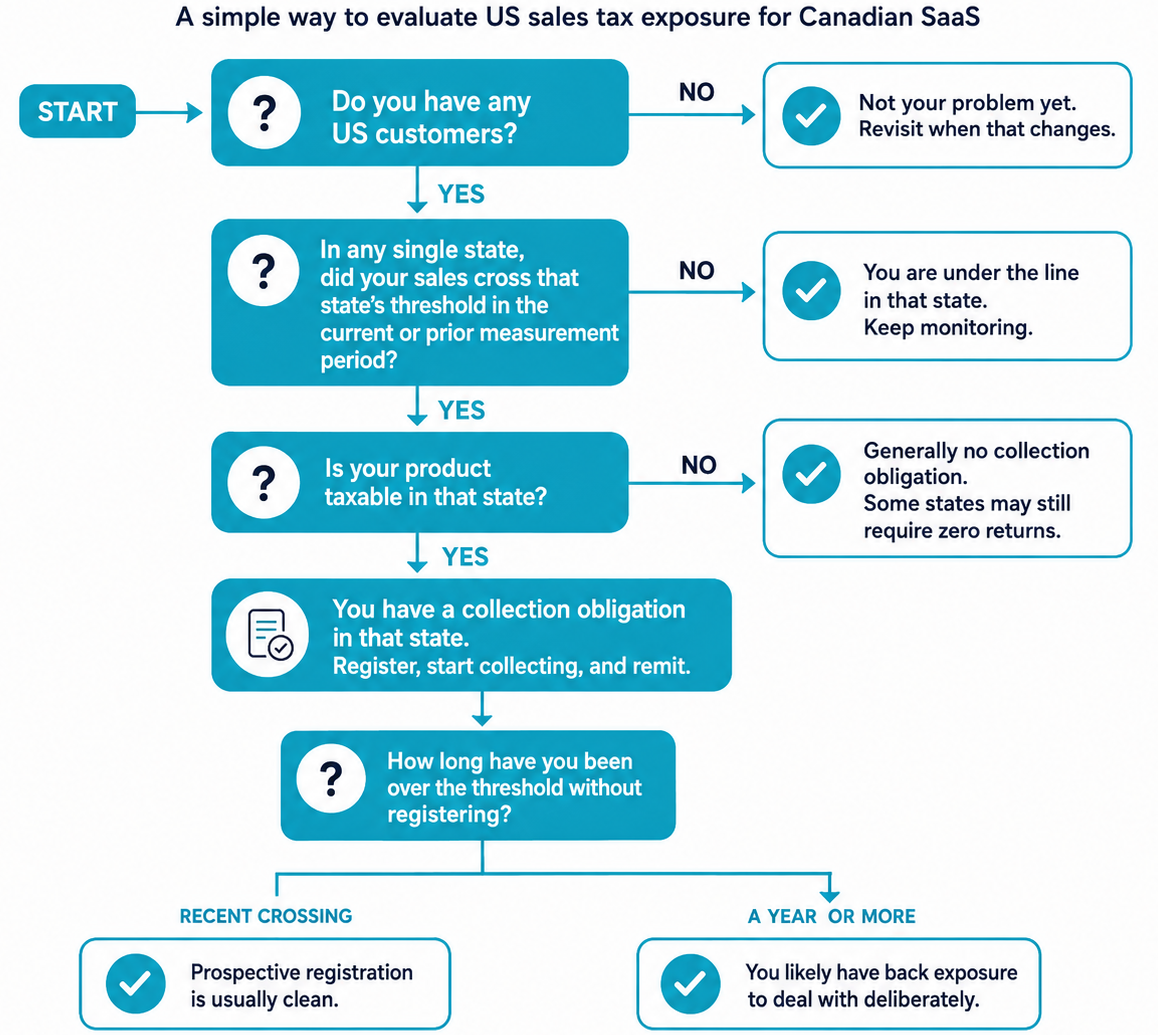
If you want a single mental model to run your US revenue through, it's this.
- Do you have any US customers? If no, this isn't your problem yet. Revisit when it changes.
- In any single state, did your sales cross that state's threshold in the current or prior measurement period? If no, you're under the line there. Keep monitoring, because you may be approaching it.
- If yes, is your product taxable in that state? If no, you generally have no collection obligation (though a handful of states still want you registered to file zero returns). If yes, continue.
- You have a collection obligation in that state. This generally means registering, collecting, and remitting. Then ask the harder question.
- How long have you been over the threshold without registering? If it's recent, prospective registration is usually clean. If it's been a year or more, you have back exposure to deal with deliberately, which is the next section.
The thing that determines your exposure is almost never step 4. It's step 5: how long the clock has been running before you noticed.
What this costs
When a state determines you had nexus and didn't register, it can assess the tax you should have collected, going back to the date you crossed the threshold. There is no statute-of-limitations comfort here that is similar to a filed return, because an unregistered, non-filing business often has no limited lookback at all. The clock runs from the nexus date, however many years ago that was.
On top of the tax, the state adds interest (which compounds) and penalties. Penalty regimes vary: some states apply a flat rate (Maine, for example, uses a flat 10% on most delinquencies), others scale with how late and how large the shortfall is.
The part that genuinely hurts: this is sales tax you were supposed to collect from your customers and pass through. Once two or three years have gone by, you usually cannot go back and bill old customers for it. So the liability comes out of your own margin. You end up paying, out of pocket, a tax that was never economically yours to bear. That is what turns a compliance oversight into a real number on the balance sheet.
This is also why "wait and see" is the most expensive option. Every month you're over the threshold and unregistered, the back-tax base grows, and the interest compounds.
How states find companies that never registered
The reason "they'll never notice us" doesn't hold up: enforcement stopped being manual years ago.
States now build profiles of likely non-filers from several data sources at once: marketplace and platform reports, payment-processor data, shipping records, business-license and public-record cross-referencing, and data-sharing between states. The shift is from reactive audits to proactive, data-driven detection.
In practical terms, if your billing system shows $400,000 of subscription revenue flowing in from Texas customers, that is precisely the kind of pattern a revenue department can reconstruct. The same dashboard that tells you the US is your fastest-growing segment is the data trail that makes you visible.
The usual first contact is a nexus questionnaire: a form asking about your activity in the state. It feels innocuous. It is not. The moment a state contacts you, you generally lose access to the one tool that limits historical exposure, which brings us to your options.
If you've been selling into the US for years and never registered
This is the situation most Canadian SaaS businesses are actually in. Three paths, in plain terms.
1. Do nothing and hope.
The exposure keeps compounding, you stay disqualified from relief the day a questionnaire lands, and you're betting against increasingly capable detection. This is not a strategy. It's a deferral with interest.
2. Register prospectively.
You register now and start collecting going forward. Clean and simple if you only recently crossed the threshold. The risk: in many states, registering does not erase the back periods, and the act of registering can prompt the state to ask when you actually crossed the line. If that was three years ago, you may have invited the back-tax conversation without the protection of a negotiated deal.
3. Use a Voluntary Disclosure Agreement (VDA).
This is the tool built for exactly this problem. Generally, in a VDA, you come forward (usually anonymously, through a representative) before the state contacts you. In exchange, the state typically caps the lookback to three or four years instead of running it back to the nexus date, and waives penalties. Interest is usually still owed. You can often run a VDA across multiple states at once.
The decision between options 2 and 3 turns on how long you've been exposed and how large the back number is. One important caveat: if you collected sales tax from customers but never remitted it, you're in a different and worse category. Several states treat that as a tax you're holding in trust, which means longer lookbacks and far less penalty relief. VDAs are most powerful for the much more common situation, where you simply never collected because you didn't know you had to.
The window for all of this closes the moment a state reaches out. The value of acting deliberately is highest precisely when you feel least urgency about it.
The reverse problem you already live with: Canadian GST/HST
There's a useful mirror here, and it's one you probably already understand instinctively, because Canada does the same thing to foreign sellers that US states do to you.
Since July 1, 2021, non-resident digital-economy businesses (think a US SaaS selling into Canada) have had to register for GST/HST once their sales to Canadian consumers exceed CAD $30,000 over any twelve-month period. Canada built a simplified registration regime for them: tax is charged based on the customer's usual place of residence, and the trade-off is that these registrants cannot claim input tax credits.
Two things are worth taking from this.
First, the principle is reciprocal. The same "your obligation follows your customers" logic that Canada applies to inbound US sellers is exactly the logic US states apply to you. If the Canadian rule feels reasonable, the US one is generally the same idea (but wearing 45 different outfits).
Second, and more practically: the CAD $30,000 figure should be familiar, because it's the same number that governs your domestic GST/HST registration. The instinct you already have about watching that threshold at home is the instinct you need to apply, state by state, in the US. The mechanics differ. The discipline is identical.
Two wrinkles that separate a real answer from a generic one
Marketplaces versus direct sales
If you distribute through an app marketplace (an app store, for instance), that marketplace may be a "marketplace facilitator" that collects and remits on your behalf, which can take certain sales off your plate. But most B2B SaaS is sold direct, billed through your own processor. When you sell direct, the collection obligation is entirely yours. Don't assume your payment processor is handling sales tax. Stripe and similar tools process payments; they do not, by default, determine your nexus or file your returns.
B2B exemptions and the resale question
A meaningful share of SaaS revenue is B2B, and some states treat business-use software differently from consumer software, or allow exemption certificates for certain buyers. This can reduce what you actually owe, but only if you're capturing the right customer data and certificates at the point of sale. It is not a reason to skip the analysis. It's a reason to do it properly, because the savings only exist if you've documented them.
What this looks like in practice
Consider a composite (the numbers below are illustrative, but the pattern is one we see often).
A Canadian SaaS does $6M in total revenue, of which $3.5M comes from US customers built up over three years. The revenue is spread across many states, with natural concentrations: roughly $700K in California, $450K in Texas, $520K in New York, and the rest scattered.
Run the two questions:
- California ($700K): Over the $500K threshold, so nexus exists. But California doesn't tax SaaS, so there's no collection obligation. (Register only if a specific filing requirement applies.)
- Texas ($450K): Under the $500K threshold, so no nexus yet. Worth watching closely, because it's close, and Texas taxes SaaS.
- New York ($520K): Over $500K and almost certainly over 100 transactions, so nexus exists, and New York taxes SaaS. This is a genuine collection obligation, and it has likely existed for a year or more.
The owner who assumed "no US offices, no US tax" has real exposure in New York that's been compounding, a state (California) where the scary revenue number creates no liability at all, and a state (Texas) that's a near-term trigger to monitor. The generic "register everywhere" approach would have them filing in California for no reason while the New York clock kept running. The blanket "ignore it" approach leaves the New York exposure to grow until a questionnaire arrives.
The right answer is neither. It's a state-by-state read of both questions, then a deliberate plan for the states where both answers are yes.
Final Thoughts
Wayfair did not create a problem that competent businesses can't handle. It created one that quietly punishes the businesses that don't look. The exposure is rarely dramatic when you find it early. It becomes dramatic only because it sits unexamined while US revenue grows.
If your US revenue has moved past the $1M mark and you've never had a sales tax conversation, the responsible move isn't panic and it isn't avoidance. It's a clear-eyed read of where you've crossed nexus, where your product is actually taxable, and how long any clock has been running. That analysis usually takes far less time than business owners fear, and it converts an open-ended liability into a known, manageable number.
This is the kind of work that's best done before a state forces the timeline. The math only gets worse while you wait, and the best tools for limiting it only work while you still have the choice to come forward.
Key takeaways
- Wayfair (2018) ended the physical-presence rule. US states can now require you to collect sales tax based on your sales into the state alone. Being Canadian with no US footprint is not a shield.
- There is no single threshold. The old "$100K or 200 transactions" line is increasingly wrong: 16 states have dropped the transaction count, and big states like California, Texas, and New York use $500,000.
- Crossing nexus and owing tax are two different questions. You only have a collection obligation where you've crossed the threshold, and your product is taxable. SaaS is taxable in roughly 24 states and exempt in others (California and Florida being notable exemptions).
- The cost is in the lookback, not the rate. Without a voluntary disclosure agreement, a state can assess back to your nexus date, plus compounding interest and penalties, and it usually comes out of your margin because you can't re-bill old customers.
- The tools that limit exposure only work before contact. A VDA can cap the lookback and waive penalties, but the option closes the moment a state sends a questionnaire.
- You already know the principle. Canada's CAD $30,000 GST/HST threshold for non-resident digital sellers is the same logic in reverse. Apply that same discipline, state by state.
Frequently asked questions
Do Canadian companies really have to deal with US state sales tax?
Yes, if your sales into a given state cross that state's economic nexus threshold and your product is taxable there. Since Wayfair (2018), physical presence is no longer required. The obligation follows your US customers, not your location.
What is the economic nexus threshold for SaaS?
There is no single number. The most common pattern is $100,000 in annual sales in a state, but many states have dropped the older "200 transactions" alternative, and larger states use higher figures: California and Texas both use $500,000, and New York uses $500,000 combined with more than 100 transactions. Check each state where your revenue concentrates.
Is SaaS taxable in every state?
No. Roughly 24 states tax SaaS in some form. Several, including California and Florida, do not tax it at all. Some, like Texas, tax only part of the charge. This is why crossing a threshold does not automatically mean you owe tax.
We've been selling in the US for three years and never registered. What now?
You have three realistic options: do nothing (not advisable, exposure compounds), register prospectively (clean only if you recently crossed the threshold), or pursue a voluntary disclosure agreement to cap the historical lookback and waive penalties. The right choice depends on how long you've been over the threshold and whether you have ever collected tax without remitting it. The VDA route closes once a state contacts you.
How would a state even find us?
States increasingly use data-driven detection: payment-processor data, marketplace and platform reports, shipping records, and cross-state data sharing. A business with significant unregistered US revenue is more visible than most owners assume.
Does this connect to our Canadian GST/HST obligations?
The principle is the same. Canada requires non-resident digital sellers to register for GST/HST once they exceed CAD $30,000 of Canadian sales over a twelve-month period, which mirrors how US states treat you. It's the same threshold-based logic you already manage domestically.
If your US revenue has grown past the point where 'we'll deal with it later' feels comfortable, it's worth sizing the exposure while you still have options. We help identify when this applies to you and connect you with the right US SALT specialists. Book a scoping call to learn more about our services.
A note on scope: ConnectCPA is a Canadian accounting firm, and nothing above should be read as US tax or legal advice. We're well-versed in spotting when US economic nexus exposure applies to a Canadian SaaS business and helping you think through next steps, but formal determinations on state-specific registration, taxability, or voluntary disclosure require a licensed US state and local tax (SALT) professional. Where that's the case, we'll help you find the right one, or work alongside your existing US counsel.
