

Finance teams believe they have to choose between closing fast and closing right. Here is where that trade-off gets made, what it costs, and why the best teams refuse to make it at all.
A scene that plays out in a lot of growing businesses: The books close on day four. Leadership gets the P&L, makes decisions, moves on. Then three weeks later, someone finds a $60,000 batch of marketplace settlements sitting in a clearing account, and last month's gross margin quietly changes by two points. Nobody re-sends the report. The decisions stand.
Here is the other version. The books are airtight. Every account reconciled to the dollar, every accrual rebuilt from scratch, every entry double-checked. The close wraps on day 22, which means leadership spends two-thirds of every month managing on numbers from the month before last.
Both teams think they made a reasonable trade. One chose speed, one chose accuracy. In practice, both are paying for the same underlying problem, and neither trade was actually necessary.
This article breaks down where teams compromise during the monthly close, why those compromises feel rational in the moment, what they cost, and how businesses in the $2M to $25M range get to a close that is both fast and reliable.
Why does the monthly close force a trade-off between speed and accuracy?
Because the close is where two legitimate pressures collide, and only one of them has a visible deadline.
Leadership wants numbers early. Every day the close drags on is a day of decisions made on stale data: pricing changes, hiring calls, inventory buys, cash moves. In a business growing 30 or 40 percent a year, last month's numbers age quickly.
The accounting team wants numbers right. They are the ones who answer for a misfiled GST/HST return, a missed accrual, or a balance sheet account that has not tied out since March. Accuracy failures surface later and are expensive to unwind.
The problem is that speed is measured and accuracy usually is not. "We closed in five days" is a number everyone sees. "Our books required zero post-close adjustments" is a number almost nobody tracks. So when the two pressures collide, and they collide every single month, the compromises tend to fall on the accuracy side, quietly, one shortcut at a time.
The teams that never seem to face this trade-off are not working harder during close week. They have moved the work somewhere else entirely. More on that below.
How long should a monthly close take?
The most widely cited benchmark comes from APQC, which surveyed roughly 2,300 organizations on close cycle time, measured from running the trial balance to completing financial statements. The median came in at about 6.4 calendar days. Top performers closed in under 5 days. The bottom quartile needed 10 or more.
For a $2M to $25M Canadian business, a realistic and healthy target is a complete close within 8 to 10 business days, with a preliminary "flash" view of revenue, margin, and cash available around day 3. Businesses with heavy transaction volume or multiple entities may sit at the upper end of that range. Businesses running clean, automated systems routinely beat it.
Where do teams cut corners when they close faster?
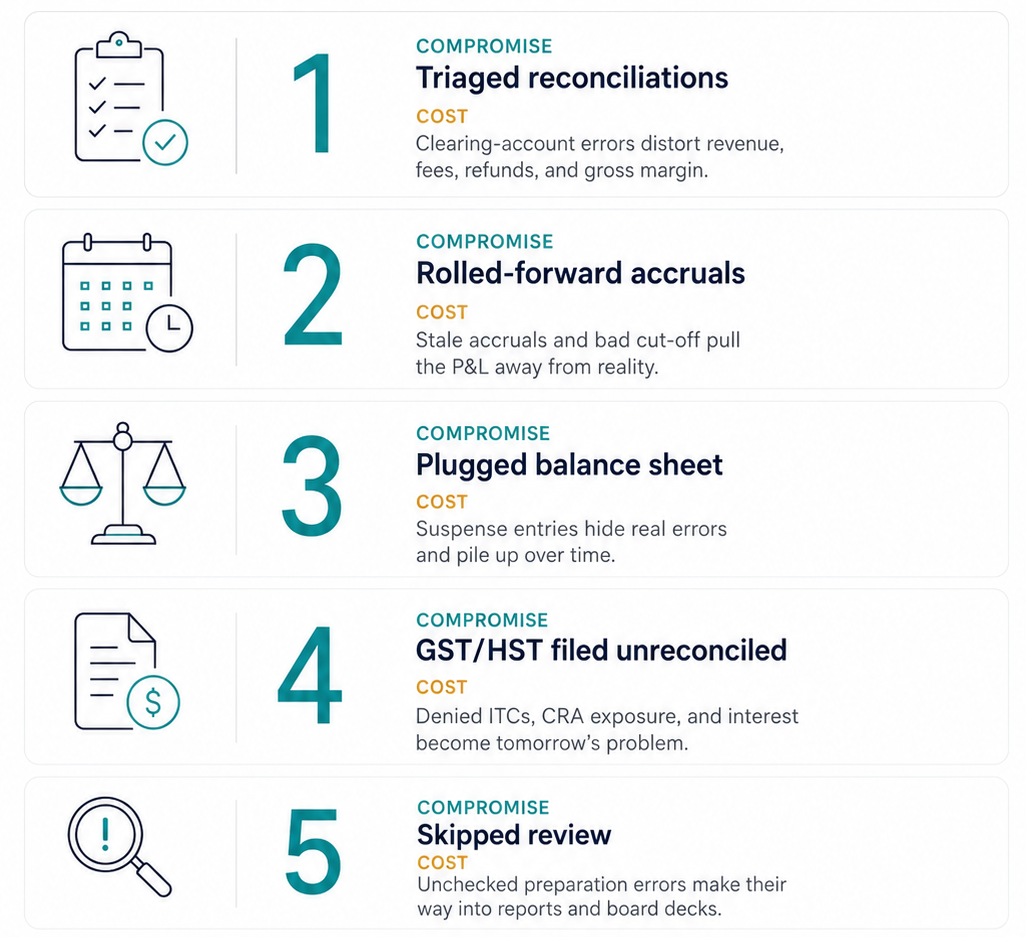
When a team is pushed to close quickly without changing how the close actually works, the shortcuts follow a predictable pattern. These are the five we see most often, roughly in the order they appear.
1. Reconciliations get triaged instead of completed
The bank account gets reconciled because everyone knows it matters. What slides are the accounts one layer down: credit cards, payment processor clearing accounts, payroll clearing, intercompany balances.
For e-commerce businesses this is where the real errors live. Stripe, Shopify Payments, and Amazon settlements all batch deposits net of fees, refunds, and reserves. If the clearing account is not fully reconciled, revenue, fees, and refunds are all approximations. A business can be "reconciled" at the bank level and still be materially wrong on gross margin.
What it looks like in practice: a $6M e-commerce company closes in four days, but its Amazon clearing account carries a growing unexplained balance. By year-end it holds $80,000 nobody can attribute. The cleanup takes three weeks and reopens two filed GST/HST periods.
2. Accruals get rolled forward instead of rebuilt
Rebuilding accruals takes time, so under pressure, last month's entries get copied forward. The freight accrual, the contractor accrual, the bonus accrual, all carried at stale amounts. Each one is individually small. Together they detach the P&L from reality a little more each month.
For SaaS businesses the higher-stakes version is revenue cut-off. Annual contracts invoiced up front get recognized when billed rather than deferred and earned monthly. A $4M ARR company that lands three annual deals in January and books them straight to revenue has just manufactured a record month, followed by eleven months of looking mysteriously flat. Every decision built on that January is built on air.
3. The balance sheet balances because someone made it balance
Suspense accounts and plug entries are the close team's pressure valve. A $3,400 difference nobody can explain gets parked "to investigate later." Later rarely comes. The suspense account becomes a junk drawer, and every dollar in it is a transaction sitting in the wrong place on the P&L or balance sheet.
A useful internal rule: any suspense item older than one close cycle is no longer a timing difference. It is an error with a hiding spot.
4. GST/HST gets filed from the ledger instead of reconciled to it
This one is specific to Canadian businesses and it is the compromise with the longest tail. Under deadline pressure, the GST/HST return gets filed straight off the GL balance without confirming that tax collected actually ties to taxable revenue, or that Input Tax Credits claimed are supported by documentation that meets CRA's requirements.
The return goes in on time, which feels like a win. The exposure surfaces only if CRA reviews the period, at which point unsupported ITCs get denied and interest runs from the original due date. Filing on time with unreconciled tax accounts is not speed. It is deferred cost.
5. Review disappears
The final shortcut is the quiet one. The person who prepared the entries also approves them. Nobody walks the balance sheet asking whether each account makes sense. Variance review shrinks to "does the P&L look roughly like last month."
This is how confidently wrong numbers make it into board decks. Preparation errors are normal and expected. Review is the mechanism that catches them, and it is always the first thing sacrificed to the calendar because its absence costs nothing this month.
What does a slow close cost you?
It would be convenient if the accuracy-first teams were simply right and the fix were to slow everyone down. They are not, and it is not.
A close that lands on day 18 or 20 means leadership operates blind for most of every month. The cash flow problem that was visible in the data on day 5 gets discovered on day 20, after two more weeks of spending. The unprofitable service line runs another full cycle before anyone confirms what the numbers already showed. In a stable business this lag is an annoyance. In a business growing fast or running thin margins, it is how small problems become structural ones.
Slow closes also tend to be less accurate than their owners believe. A 20-day close usually is not 20 days of careful work. It is 4 days of work spread across 20 days of waiting: for missing invoices, for someone's expense report, for a question nobody answered. Stretched timelines create their own errors, because context evaporates. Reconciling a transaction 6 days after it happened is straightforward. Reconciling it 26 days later results in a lot of “I don’t remember what this was for” answers.
And there is a quieter cost. Teams stuck in perpetual close never get to the work that actually uses the numbers: forecasting, margin analysis, pricing support. The close stops being a means to an end and becomes the whole job.
Is the speed vs accuracy trade-off actually real?
At the margin, yes. On any given close day, an hour spent investigating a variance is an hour not spent finishing the checklist. But as a structural description of how closes work, the trade-off is mostly false, and believing in it is what keeps teams stuck.
Here is the tell: the same businesses tend to be slow and inaccurate, while the best teams are fast and clean. If speed and accuracy were genuinely opposed, you would expect fast-sloppy and slow-precise to be the two stable outcomes. That is not what shows up in practice. Both failure modes trace back to the same root cause, which is that the close is absorbing work that should have happened during the month.
When transactions are categorized weeks after the fact, when receipts arrive in a year-end shoebox rather than at the point of purchase, when clearing accounts are touched twelve times a year, then closing the books means reconstructing the month from scratch. Reconstruction is slow, and it is error-prone, at the same time, for the same reason. Speed and accuracy are not competing priorities. They are joint symptoms of process quality.
That reframe matters because it changes the fix. You do not solve this close by working harder during close week. You solve it by shrinking what close week has to contain.
How do you close faster without losing accuracy?
The pattern across businesses that get this right is consistent. Five moves do most of the work.
Push the work into the month.
Bank feeds categorized daily or weekly, not monthly. Receipts captured at the point of spend through a tool like Dext rather than collected at month-end. Clearing accounts reviewed weekly. By the time the month ends, most of the close already exists, and day one is confirmation rather than construction.
Set materiality thresholds and honour them.
Chasing a $40 difference on an immaterial account costs the same hours as chasing a $40,000 one. Decide in advance which accounts must tie exactly (cash, payroll liabilities, GST/HST) and which get investigated only past a defined threshold. Precision on immaterial balances is not accuracy. It is a hobby.
Enforce a hard cut-off.
A close that reopens for every late invoice never actually closes. Set a cut-off date, accrue estimates for anything missing, and true them up next month. One documented estimate beats an indefinitely open period every time.
Run the close from a checklist with named owners and dates.
Not a mental checklist. A written one, where every task has a person and a deadline, and the sequence is the same every month. This is also what makes review possible, because a reviewer can see what was done, by whom, against what standard.
Split the close into two tiers.
A flash report by day 3 covering revenue, gross margin, and cash, clearly labelled preliminary. The complete, reviewed close by day 8 to 10. Leadership gets decision-speed, the accounting team gets accuracy-time, and the trade-off dissolves because the two audiences were never asking for the same deliverable in the first place.
Then measure both sides. Days to close is the speed metric everyone already tracks. Add the accuracy metrics almost nobody does: the number and dollar value of post-close adjustments, the percentage of balance sheet accounts fully reconciled, and the age of the oldest suspense item. A close is only as good as its worst month on that second list.
This is also, frankly, where structure beats willpower. Businesses that close fast and clean almost always have someone who owns the close as a process, whether that is an internal controller or an external accounting team running a documented month-end system. The discipline is not a personality trait. It is a design decision.
Final Thoughts
The speed vs accuracy debate inside most finance teams is a symptom, not a real dilemma. Teams that believe in the trade-off keep making it, month after month, shipping either late numbers or wrong ones. Teams that fix the underlying process stop having to choose.
The practical sequence: measure your current close honestly, including the post-close adjustments you are not counting. Move daily work out of close week. Set materiality rules and a hard cut-off. Run a written checklist. Ship a flash report early and a reviewed close by day 10.
A business running on numbers that are both timely and trustworthy makes different decisions than one running on either alone. That difference compounds every month, which is exactly how often you get to close the gap.
Key takeaways
- Speed is visible and accuracy is not, so under pressure, accuracy is what quietly gets compromised: triaged reconciliations, rolled-forward accruals, suspense-account plugs, unreconciled GST/HST filings, and skipped review.
- Slow closes carry their own costs, mostly in decision lag, and are usually less accurate than their owners assume.
- The trade-off is largely false. Fast-and-clean closes and slow-and-messy closes are both outcomes of process quality, not effort allocation.
- The fix: push work into the month, set materiality thresholds, enforce hard cut-offs, run a written checklist with owners, and split the close into a day-3 flash and a day-8-to-10 full close.
- Track accuracy the way you track speed: post-close adjustments, reconciliation coverage, and suspense-item aging.
Frequently asked questions
Q: What is a good month-end close time for a small or mid-sized business?
A complete, reviewed close within 8 to 10 business days is a healthy target for most businesses in the $2M to $25M range, with a preliminary flash view of revenue, margin, and cash around day 3. Benchmark surveys put the overall median near 6 calendar days, but that figure skews toward larger businesses with dedicated close teams.
Q: How do I know if my fast close is actually accurate?
Count your post-close adjustments. If entries routinely land in a period after it was declared closed, or prior-month numbers keep shifting, the close is faster on paper than in reality. Well-run closes see very few adjustments after sign-off.
Q: What should be reconciled every single month, no exceptions?
Cash, credit cards, payment processor clearing accounts, payroll liabilities, and GST/HST accounts. These are the accounts where errors compound fastest and where CRA exposure is most direct. Lower-risk balance sheet accounts can run on a materiality threshold.
Q: Is it acceptable to file a GST/HST return before the books are fully closed?
Filing on time matters, but the tax accounts themselves should be reconciled before filing: collected amounts tied to taxable revenue, and Input Tax Credits supported by compliant documentation. Filing off an unreconciled ledger balance trades a visible deadline for an invisible liability.
Q: What is a flash report and do I need one?
A flash report is a preliminary summary of revenue, gross margin, and cash issued in the first few days after month-end, before the full close is complete. If leadership is pressuring the close timeline, a flash report usually resolves the tension, because the pressure is almost always for those three numbers rather than a finished balance sheet.
If your close is fast but keeps getting restated, or accurate but arrives too late to matter, the process is telling you something. ConnectCPA runs structured month-end close systems for Canadian businesses that need numbers they can act on, delivered on a timeline that makes acting on them possible. Book a call to learn more about our services.
