

It's the 22nd of the month and your leadership meeting is tomorrow. You still don't have the prior month's financials. There's a draft P&L with a handful of items not accounted for yet, a bank reconciliation that's mostly done, and a bookkeeper working late to get the rest over the line. By the time the financials are complete, the month they describe is already six weeks behind you.
The instinct is to look at the people. Is the bookkeeper too slow? Do we need another hire? Should everyone push harder at month-end?
In our experience, that's rarely the problem. A slow close is typically a design problem. The work happens in the wrong order, at the wrong time, and often by the wrong person. Asking anyone to work faster doesn't change any of that.
How long should the month-end close take?
For most of our controllership clients, close lands in 8 to 10 business days. Clients who report to lenders or investors, including those with debt covenants, often need numbers sooner, and for them we close in as few as 3 to 5. Where a business falls in that range depends on its books. High transaction volume or several subsidiaries add time. Clean books and automated systems take it away.
What improves the timeline isn't how hard anyone works; but rather, how much of the close is finished before the month ends. Here's how the workflow runs for a client on a 7-day close.
Why does month-end close take so long?
A long close usually occurs when reconciliations are left until month-end. Transactions sit uncategorized for the whole month. On the first business day of the close, the bookkeeper starts coding 30 days of bank and card activity at once. Halfway through, they hit transactions they can't identify and email the business owner. Then they wait.
Meanwhile, reconciliations can't finish until those answers come back. Accruals get pieced together from memory and inbox searches. If anyone reviews the numbers at all, it's whoever notices the P&L looks unusual. Each step waits on the one before it, and every open question adds days of idle time to the chain. That's how a 20-day or 25-day close happens while everyone is working hard.
The cost is bigger than inconvenience. Decisions on hiring, pricing, and spending get made on numbers that are a month or more old. Lender reporting deadlines get tight. And if you file GST/HST monthly, your return is due one month after the period ends, so a slow close leaves almost no time to review the return before it goes to the CRA.
We've written about the trade-off between close speed and accuracy separately. The short version: a faster close and a more accurate close come from the same changes. You don't have to pick one.
Close speed is all about workflow
We have never shortened a client's close by asking our team to work harder. Every improvement has come from changing what we do and when we do it.
Three structural changes do most of the work. First, transactions are processed continuously during the month instead of in a month-end batch. Second, close follows a fixed order of operations, tracked in a checklist, so nothing waits on something that should have happened earlier. Third, a controller, not the bookkeeper who coded the month, handles the month-end procedures and review. The rest of this post shows what that looks like in practice.
What does a 7-day month-end close look like, day by day?
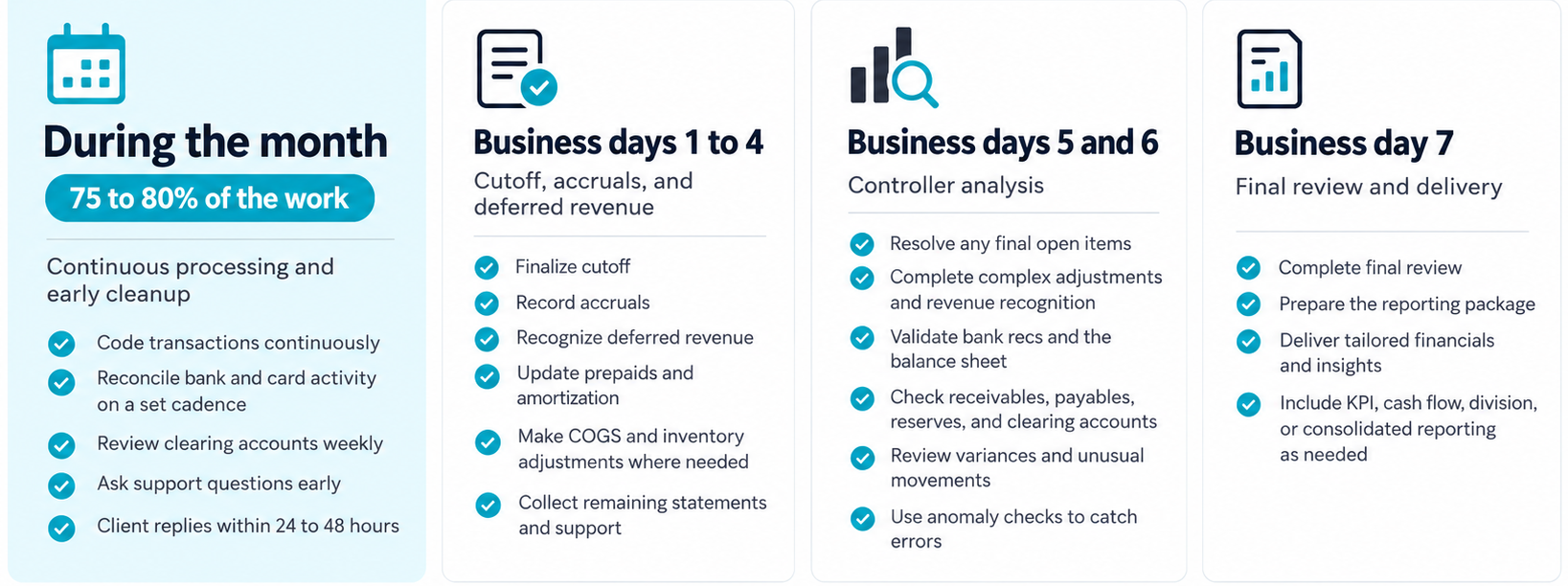
For a client on a 7-day close, the work falls into four stages, and most of it happens before the month is over.
During the month: where 75 to 80% of the close happens
Our goal is to finish 75% to 80% of close work before the month ends. Transactions are coded and bank accounts reconciled on a set cadence: weekly for mid-to-large clients, roughly $10 million to $50 million in revenue, and twice a month for smaller ones. Clearing accounts are reviewed weekly, because that's where payment processor fees, refunds, and payouts tend to go wrong. When something needs support, we ask right away, and every client agrees up front to answer open questions within 24 to 48 hours.
Here's what that looks like for a hypothetical SaaS business with $4M in annual recurring revenue. It bills most customers through Stripe, pays for hosting on a corporate card, and works with contractors who invoice them (but have the tendency to forget to invoice on time). In a single batch model, all of that gets untangled on day 1 of close. In a continuous model, Stripe payouts are matched to invoices as they occur, hosting charges are coded weekly, and the missing contractor invoice is already on the accrual list. By the time the month ends, what's left is genuinely month-end work.
Business days 1 to 4: cutoff, accruals, and deferred revenue
What's left at month-end is the work that depends on the full month being over: deciding which accruals are needed, how much deferred revenue to recognize, cost of goods sold and inventory adjustments for product businesses, and validating prepaids and their amortization. Remaining statements and support get collected.
Deferred revenue is the one that surprises people most. Say a customer pays $120,000 in January for a one-year subscription. Without a deferral, January shows $120,000 of revenue and the next 11 months show none from that customer. With a deferral, each month shows $10,000. The first version makes January look spectacular and makes the rest of the year look like a decline that never happened.
By business day 4, the cutoff is firm. Any invoice that's on its way gets accrued rather than waited for, because reopening the books for late items is one of the fastest ways to lose a week.
Business days 5 and 6: controller analysis
By day 5, everything is in. If anything is still open, we hold a short check-in call with the client to settle it. Then a controller works through the month-end procedures for every client, every month: complex adjustments like revenue recognition, confirming accruals are complete, validating the financials, and analyzing trends to catch unusual movements.
The first checks are usually the basics. Do the bank reconciliations tie out, and is anything still uncoded? Does the balance sheet reflect the business's actual position: is inventory right, do clearing or miscellaneous accounts need attention, are any accruals or reserves stale, are receivables and payables accurate, and does any revenue need deferring or releasing? Then the controller looks for unusual movements, like a missing expense, a capital purchase that was expensed, a new shareholder loan, a debt repayment, or an equity change.
Variance thresholds are set with each client. A nonprofit working within a restricted budget may want anything over 5% explained, while many for-profit businesses are comfortable at 10%. Thresholds get refined as we learn the business. Automated checks in Dext Precision flag anomalies a manual review can miss.
Variance review is as much an error check as an explanation exercise. If rent jumps 40%, it's either a new lease or a double-posted bill. If software spend rises sharply in one month, an annual renewal may have been expensed in full instead of recorded as a prepaid. Both are cheaper to fix during review than after the financials have gone to the board.
Business day 7: final review and delivery
Day 7 is final review, then delivery. The reporting package isn't a fixed template. We agree on it with each client at the start of the engagement. Some need statements by division or comparisons with prior periods. Multi-entity groups need consolidated reports. Businesses selling both B2B and direct-to-consumer need revenue segmented. Some want a short-term cash flow forecast, others a full operating year. Scaling businesses often need KPI tracking or a dashboard built around their industry.
What we deliberately don't do during close
We avoid asking clients coding questions during close wherever we can. Those questions get asked during the month, when there's time to answer them properly. A question sent on day 3 of close turns the client's response time into our close timeline. It's a small rule, but it changes the client's experience at close. Instead of a flurry of urgent emails at month-end, they get a short list of questions spread across the month and a finished package at the end.
What delays a month-end close?
The most common cause is waiting on the client: an unanswered question, or a statement we can't get ourselves, like a bank or credit card account we weren't given access to. When we can, we make a professional judgment on how to code the item so that the close keeps moving, flag it, and true it up once the support arrives. Complexity matters too. The complexity of the business also plays a part. Large transaction volumes and multi-entity structures lengthen the close, while clean books and automation shorten it.
What we usually find when we take over a new client's books
Clearing accounts are a common one: balances made up of unexplained transactions that grow year after year, often hiding expenses nobody has accounted for. E-commerce books have their own patterns. Shopify, Amazon, and Stripe payouts get recorded as a single lump-sum deposit to revenue, mixing sales with fees, sales tax, and discounts. Gift card liabilities get ignored entirely. Cost of goods sold ends up in operating expenses, or the reverse, which distorts margins.
Deferred revenue accounts carry balances from years back that were never released, so revenue was understated. Intercompany balances across entities don't match. And incorrect tax codes in the ledger mark purchases as exempt, so input tax credits the business was entitled to never get claimed.
What does a faster close require from your business?
A 7-day close isn't something we can achieve ourselves. It needs a few things from the business. Direct bank feeds into the accounting system, so transactions arrive without anyone exporting statements. Answers to open questions within 24 to 48 hours. Receipts and bills captured as they happen rather than collected at month-end. And a willingness to standardize the chart of accounts, so the same kind of transaction lands in the same place every month.
The setup is heavier than most business owners expect. Cleaning up the chart of accounts, connecting feeds, and building the accrual and deferral schedules takes real work up front. For most clients, a structured onboarding gets there in about three months, if everything stays on schedule. After that, the ongoing burden on the client drops, because the questions come in small batches and the month-end scramble disappears.
How do you know if your close process is the problem?
A few signs suggest the workflow is the constraint, not the people running it. Your close regularly takes more than 15 business days. Your bookkeeper sends a long list of questions at the end of the month instead of a few during it. Numbers change after the financials have already gone out. Nobody besides the person who prepared the books reviews them. Or the review covers the P&L but not the balance sheet.
If two or more of those sound familiar, hiring another bookkeeper probably won't help. Another person working the same batch process just produces the same late close at a higher cost.
This is where controllership makes the difference. Our controllership clients get the full workflow described here: continuous processing during the month, a structured close checklist, controller-level review, and a reporting package built around what each client needs to decide.
Final Thoughts
A 25-day close isn't a sign that your team isn't trying. It's a sign the workflow was never designed to close faster. The fix is architecture: move the work into the month, run close in a fixed order, and put a reviewer between the books and the people who rely on them.
The cost of leaving it alone is quiet but real. Every month, you make decisions on numbers that are already old, and every month the gap between what happened and what you know about it stays the same.
If your close regularly runs past 15 business days and you'd like a second set of eyes on the workflow, we are happy to talk it through.
